Sneaky Ninja – Stealth based level design
|
This is a short blog post with some of my general thoughts and ideas that I got while designing the levels for Sneaky Ninja. This was the first time I designed levels for a stealth game so I thought I would write down some of the problems I encountered and how I solved them. When I fist started designing the first level for Sneaky Ninja I was thinking about it like a puzzle game, but I quickly realized this was not the correct approach because of the way the game was designed with an arsenal of different items the player could choose and use in each level. It’s nearly impossible to design a puzzle with a “perfect solution” that works for every item in the game, therefore I decided to go for a more open, “stealth-like”, approach to designing my levels. I tried to create two our more different paths that the player could take through the level and each path would challenges where some items are more useful than others. We discovered early in testing that balancing the items, (range, amount of uses, etc), would be crucial for our game. In one of our early tests we had just a default amount of three for each item, for some items this was fine but for the grappling hook for example it was completely broken, if you used the grappling hook with three uses you could complete almost any level by completely bypassing most challenges. Another decision that was made that influenced the level design was that the player would not only have to get in and steal the plans they also needed to find their way back out. Not only did this make more sense “logically” it also let players explore the different paths in the map on their way in and then out, without having to replay the whole map. A thing I noticed in testing and that I then started using more in my levels was that players expected guards to have a “circular” patrol path, I also noticed that guards with circular paths where very easy to avoid as the player could simply move behind the guard knowing there was no risk in being discovered. In order to make guards less predictable and harder to avoid I started using more irregular patrol patterns, some of my favorites was simply a L-shaped patrol path or U-shaped, this would often trick a inattentive player that the guard would do a usual complete circular path, but instead the guard would turn and catch the player as he/she tried to sneak behind. Here’s an exemple from the first level I designed (Level 2 in the game). This is one of the first challenges in the level, at first the guard path was as in this picture: 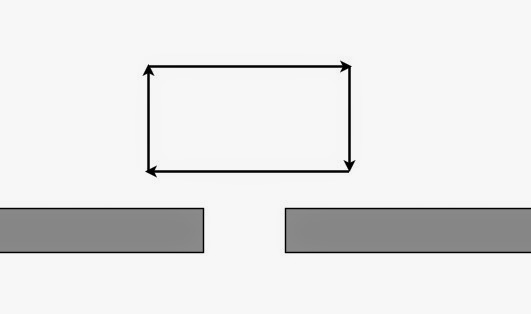 Here the player could simply wait until the guard walked past the gate and then fall in behind the guard and sneak behind him until he turns to the right and then simply continue straight on. 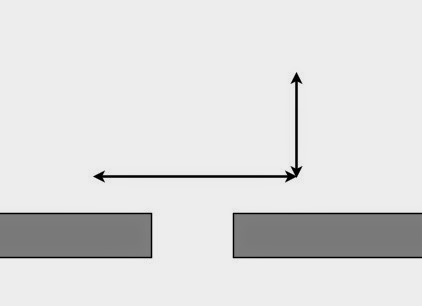 With this path the guard guards a smaller area but instead is more active within that area, making it harder for the player to avoid being detected. Many players would try walking out behind the guard just as he moves past the opening, only to have the guard turn around and detect them. |