5SD064 – Game Design Blog 01/03
|
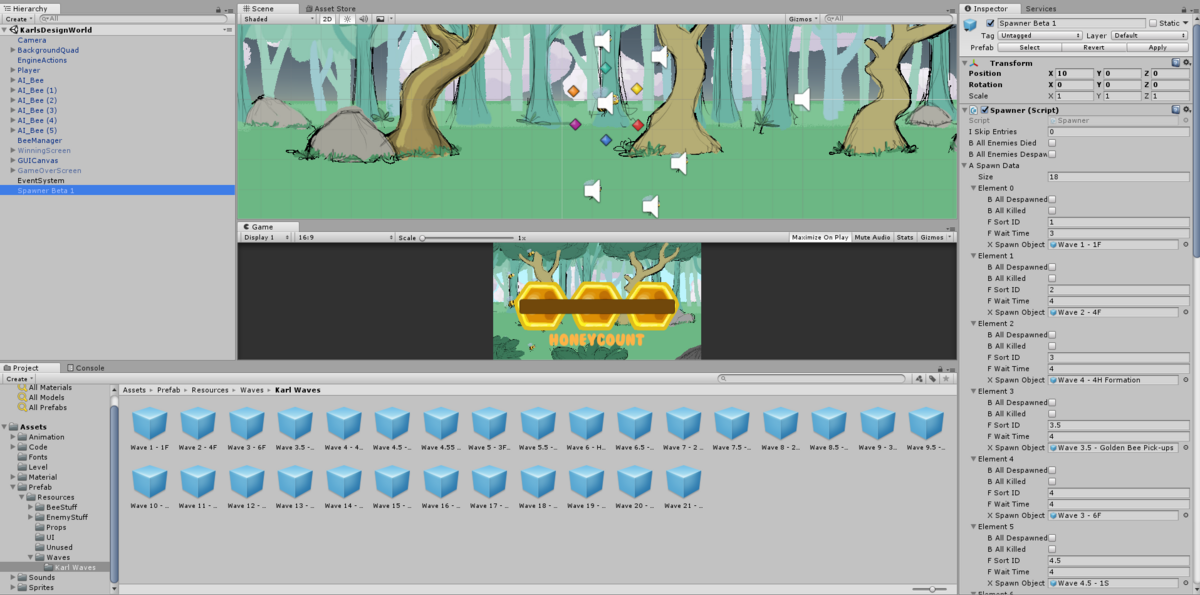
Level Design and the introduction of difficulty, enemies and mechanics. Hello again! This is the fourth blog post on my game design blog and this week I will describe my process of designing the level for the game our team is currently developing – Beelonging. To begin with, Beelonging is what’s called a ”Shmup”, that stands for ”Shoot ‘em up”. It’s one of the earliest concepts of classic game design. Amongst famous retro arcade games you might’ve heard of games such as ”Galaga” or ”Gradius”. These can be organized further and our game is a side-scrolling shoot ‘em up, which means the screen scrolls continuously at a set pace. While level design in a platforming game such as Super Mario Bros. includes a lot of design when it comes to the environment which is used in the platforming gameplay, the level design in a shoot ‘em up is based around the waves of enemies that flies across the screen and the Player needs to shoot down for points. I read an article about level design for shoot ‘em ups that described the process as the creation of a symphony. The enemies comes in many different variations of waves. You may start out simple, introduce different enemies at different points, introduce large waves that comes in somewhat like snake. Good level design makes the waves should flow together in a very natural way – like a symphony. So how did I go forward with this in mind? Beelonging is being developed in the Unity game engine. In my Design minor we’ve been taught some basics on how to work within Unity, so I felt at least somewhat familiar with it. The question was how to easiest create, organize and implement different waves into the game. The solution came from our programmers. They asked me what exactly I would wish for in a simple spawning system, and then they got to work and coded a program within Unity that has helped me tremendously with level design. In short, I have a folder with all the enemies, and I can simply drag them into a list. Within this list I can then decide which wave should come at what point in the game, I can change their positions based on a classic XY-coordinate system. It looks like this:
At the bottom left corner is the folders in where I can find the various enemies, the bottom middle shows what’s inside a folder, in this case the waves I’m currently working on, and on the right side is the list in which I drag enemies and waves and where I decide their time and position within the level. Next up is the question of balance. You can’t start the very first level of a game by having a massive wall of enemies rush the player. You need to introduce the controls, the mechanics, the enemies and gradually increase difficulty as the player learns about the game. So, in my first version of the level, the game starts out with a few second of breathing room in which the Player prepares their mind and hands. After those seconds the very first enemy appears – just a simple fly. The Player can see that the enemies comes from the right side of the screen, and by pressing Space the Player shoots out a ball of Honey and defeats the fly. The next wave is four flies, two at the top, two at the bottom. This is to incline the Player to start moving around to shoot enemies at different positions. The third wave is a group of flies spread out across the screen, to test out what the Player has just learnt about controls and shooting. This is a simple way of introducing mechanics while increasing difficulty. Each new enemy will be introduced alone, as to show the Player how this enemy works, before combining that enemy with others in larger waves. There will also be situations where we introduce our Power-up – the Golden Honeycomb, and a larger wave right after so the Player can immediatly test out their newly found Power-up. As the level design work goes on, challenges will include coming up with creative combinations of enemies within a wave. The final version of the game is expected to be aroun 5-7 minutes of gameplay. With four different enemies to create waves with, it will all be about creating fun challenges to not make the level boring. To help me out I report to my team when I have a newly updated level which I then have them try out and give me opinions on. That’s it for now, next blog post will be a reflection on the Playtesting sessions! // Karl Lindkvist  |