Week 1, Design
|
Hello everyone!
We are just about to start production on our game. But firstly, we needed to break down the concept. The game is a 3D puzzle adventure game with horror atmosphere where you’re able to switch dimensions to solve the challenges ahead. The concept was too vague for us to start working on so I laid down the base design of the game this week. The problem with the concept was that when we were discussing what kind of gameplay there would be, we came back to the puzzles themselves, and they all ended up the same way. There is an object in the way of the player, the player press walks pass object and press . Starting from this point, we decided to change up the design a bit compared to the concept. We laid down the intended aesthetics and worked our way from there with the core mechanics.
We wanted to create a feeling of vulnerability with two types of gameplay. Dimension 1: Vulnerable state after being drained of power Dimension 2: Vulnerable because overwhelmed with power So putting that into an MDA framework it would look something like this**:
GOAL: A puzzle adventure where every decision is questioned. DEFINITION: That the player feels stressed in dimension 2 and paranoid in dimension 1. SUCCESS: * The player experience uncertainty in their decisions * The player feels powerful but exposed * The players failures depends on their decisions FAIL: * The player experience that their ability to make decisions are of less importance than their in game abilities. * Atmosphere and environment does not convey intended dynamic of stress and/or stealth * The player’s power feels disproportionate to the challenge To create a feeling of vulnerability we decided to use resources in the form of health. This resource was not only for the player to have a measurement of the state he or she was in, but serve as a pool of points to use when switching dimension and using abilities. * Interaction with heavy objects, also by sacrificing a part of their health to move objects that were not able to be moved otherwise to solve puzzles in a different way. * Time spend in dimension 2 cost resources per second spent in it.
The reason we decided to go with health was that it is generally accepted to correlate with how capable the character is to perform X task.
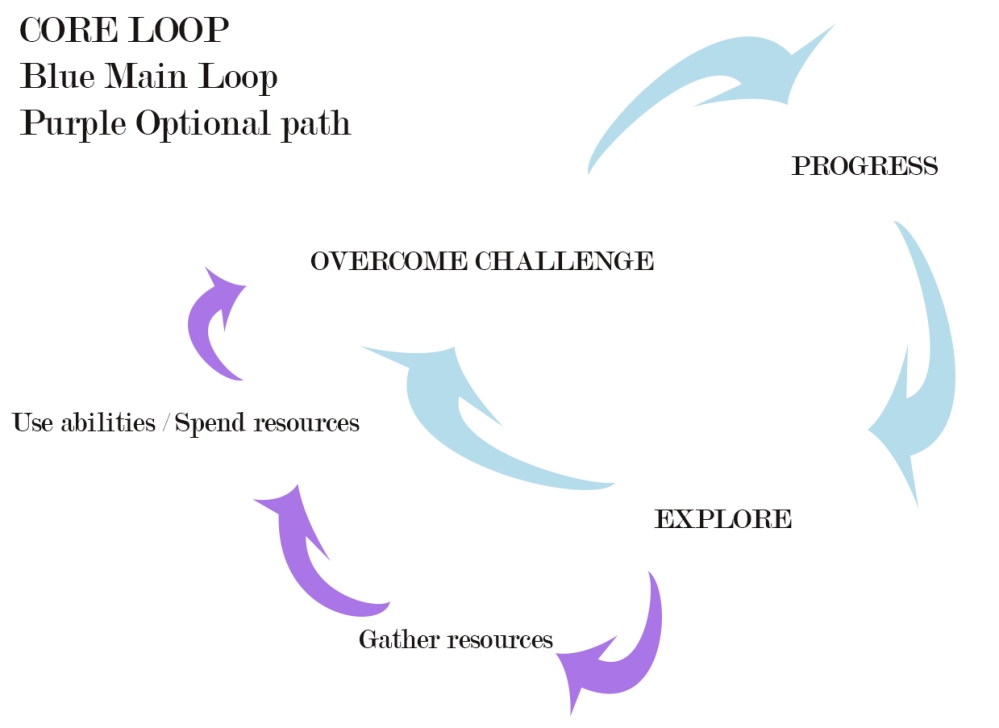
Explore -> Gather resources -> Use abilities ->Solve puzzles -> Progress -> (Repeat)
To limit the player’s control and contribute to the horror atmosphere, we decided to go with a handheld controller as our input device. This decision was made early on as it affected the way the puzzles could be laid out and how the game is played.
** Taking from our design document, with slight modifications Talk to you next time! //Oskar  |