Fancy Mansion: Aesthetic Goals
|
This week has been spent polishing our game design document before the deadline. Since we’ve prioritized the document, I won’t be programming until friday – so this week I’ll take you through how I wrote the aesthetic goals document! Disappointing, huh? I bet you couldn’t wait to hear vague descriptions of vectors and pointers and recursive functions! Our defining aesthetic goals for Fancy Mansion (release title: Trespawsser) are discovery of the unknown, and the challenge of going undetected while groping around in the dark – literally!
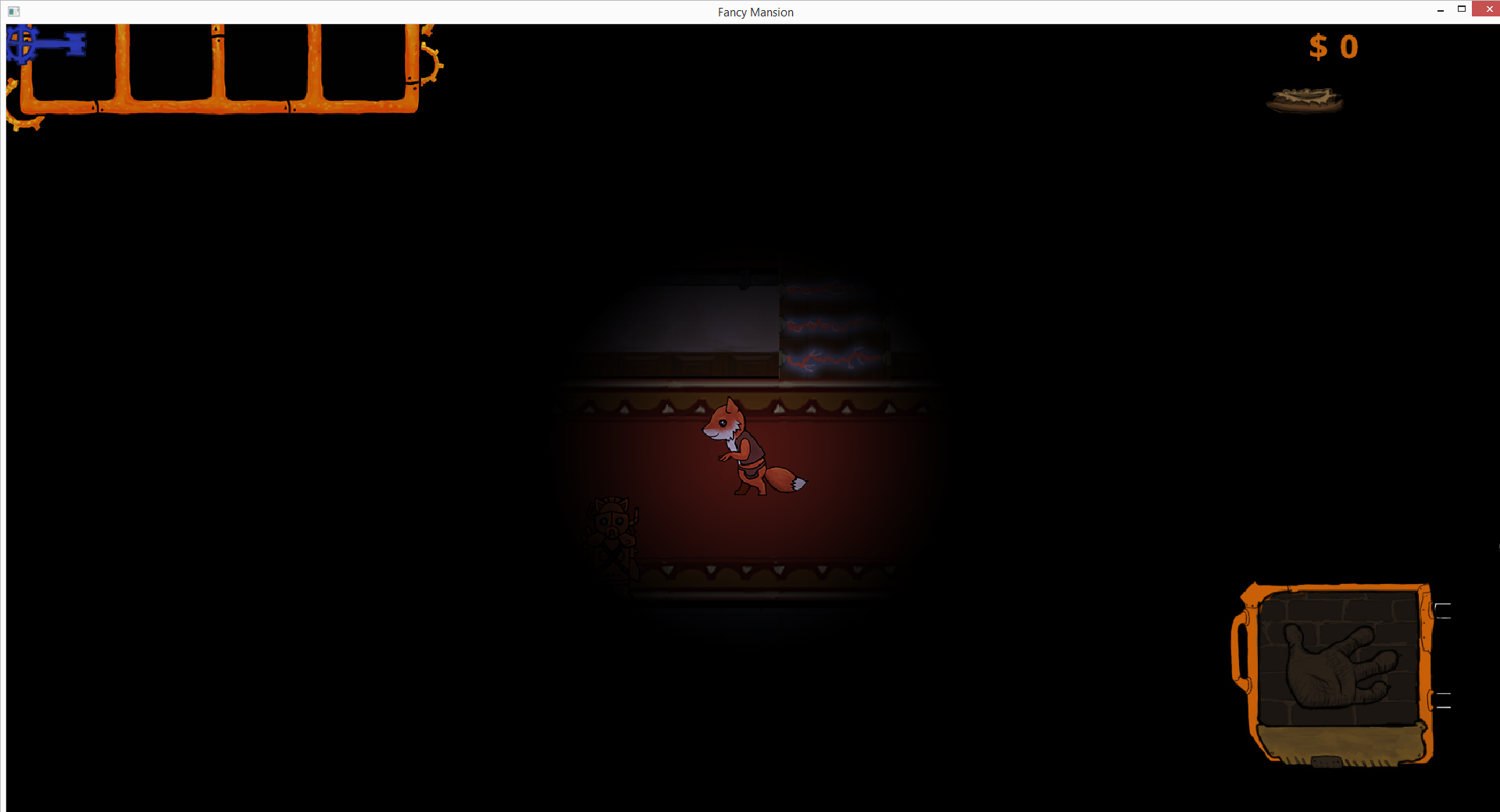
In order to create the sensation of exploring the unknown, we’ve employed a harsh light radius with utter darkness beyond, and given the player a boomerang (now being reimagined into a steampunk drone) they can throw to illuminate the area along the thrown path. The player has no minimap or indicators telling them which way to go – they have to discover this for themselves! I initially wanted the level to be much more mazelike, and we intended on multiple floors, but keeping in mind that the target audience for this game is children, and the max playthrough time is limited to 15 minutes, we’ve gone for one floor. I’ve already discussed the changes I’ve implemented to our level design and why the C-shape is effective for our goals. Click here for that post. In-game, the player’s vision will be limited, as in the screenshot below.
Another aesthetic goal of ours is the challenge of sneaking about undetected. In order to accomplish this, there are a number of things to keep in mind:
Coupled with the new level design, I think we’ve managed to fulfill all of the successes and avoid the modes of failure for the challenge of sneaking around. We have a creaky floor trap that I explained in the Level Design post (Several floortiles, indicted by a cracked floor visual, are “creaky tiles:” they emit a loud sfx and visual soundwave much larger in radius that the player’s normal footsteps. Since Otto’s sprite has collision with player-created soundwaves, this larger soundwave has a higher risk of aggroing Otto). If the boomerang/drone collides with a wall, it will likewise emit a loud sfx and visual soundwave that is more likely to aggro Otto. Otto follows the patrol route outlined in my previous post, but will investigate an area if he hears a loud noise (more on that here). This way we mesh an ai that is reactive to the player with an ai that has its own set behaviours (a default patrol route that constitutes a danger to the player, who must always return to the balcony to drop off their loot). Since this game is meant to be targetted at a younger audience, we do not wish to make the gameplay too punishing. However, the player will still die upon taking one shot from Otto’s tesla gun, unless the player is currently carrying a large loot item such as a grandfather clock, that will shatter but protect the player from one hit, or wearing a suit of armour. However, since the max playthrough time is set to 15 minutes, there won’t be a huge amount of lost time, should the player die and have to restart. One aspect we haven’t yet accounted for, is that we should ideally have a rangen that places the loot objects, keys, electrified gates etc around in different areas on the map. We most likely won’t have time to implement a proper function for this, but depending on how far we get on Friday/over the weekend, we’ll see if we have time to attempt it. Alright, that’s it for now! A playable version next week!  |