#3: Backlogs and the push/pull method.
|
When I started thinking about how my team could get the most out of our backlog I came to think about the problems surrounding how it is utilized. The traditional way is for the management to push items from the backlog. You can think of this like a manager holding “work” in his hands and giving it to a team member telling him to commit to creating this work item until the deadline.
In my team I found that we had big problems using the pull method when the team as a whole lacked the motivation and routine to using it. On the other hand I find that the pull system has been a big improvement since our group become better at handling responsibilities. As a producer I found that one of the best methods to improve our work was to give decision power to my leads so that they could self-organize and create a good workflow. Many problems that needs to be fixed is taken care of as they arise instead of having to go through the process of asking the team about every detail first. Even If not entirely self-organizing it became clear that the team seamed more involved and interested in the project as they got to manage their own work. It also made work easier to manage on a week to week basis. Some weeks you have more time than others. Many times we have actually been able to go way beyond our weekly sprint plans. Many times I think that this is because the team thinks that what they work with is interesting while they also feel that the work items aren’t forced on them. We priorities the work and then take the parts that are most necessary and then chose in accordance to what has to be done and how much time we have. In the case that the team finds that we have made an error in our priorities everyone in the team can stop the process to correct the error. If the problem is small enough the problem is fixed on the spot without stopping the process. A lot of this would not be as easy if we used a push system were I take chose what needs to be done in the backlog and then give the work items to my team. In conclusion I find that in my team as we got organized and motivated enough to make use of the pull method we improved greatly. Morale, efficiency, quality and communication is becoming better. I won’t say that all of this is solely because of the pull method. It is a combination of many things. But the pull system is a good approach for small teams that can handle it. Sometimes the push method is just better. But in the majority of the time as soon as you got a team that works and everyone pulls their own weight then you know it’s time to change. It is also worth noting that sometimes this change between push and pull can actually change someone from doing nothing into taking up phase and start working. Don’t be afraid to try. But don’t forget to plan as a team. Good luck  |
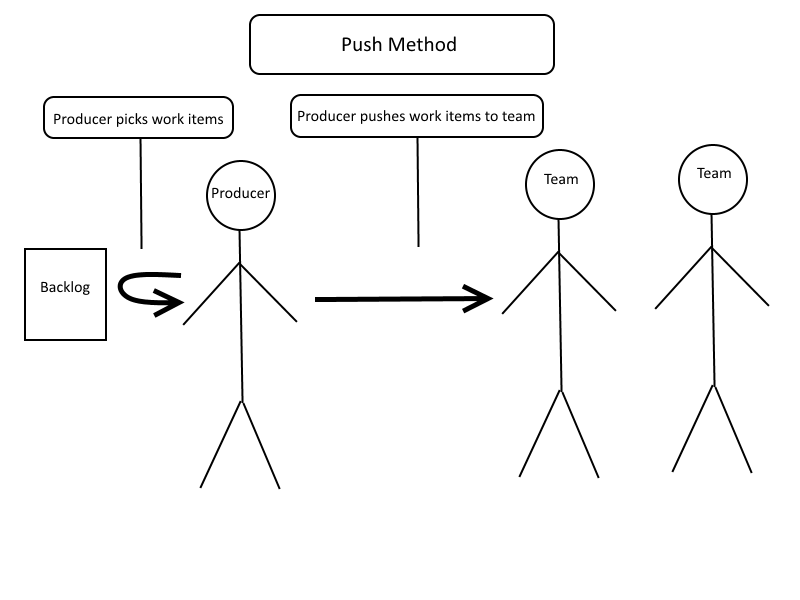 The other way around is for the team to pull things from the backlog. Compared to the last example the team gets to look at what needs to be done in the backlog and then plans out how much they can commit to create under a given time period (example, a 2 week sprint).
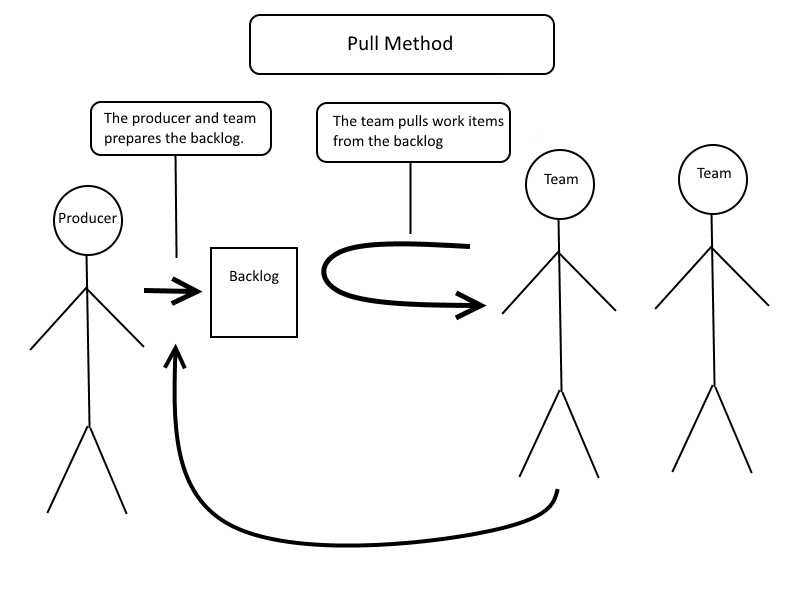 Both methods have benefits and disadvantages but when it comes to small companies, or let’s say university teams trying to create a space shooter. I find it best to use the pull method. But like any agile method or process the pull method demands that the team takes responsibility and is self-organizing. If not you will find yourself in a situation where everyone is sitting and doing nothing while they wait for someone to take the initiative of organizing the work processes.