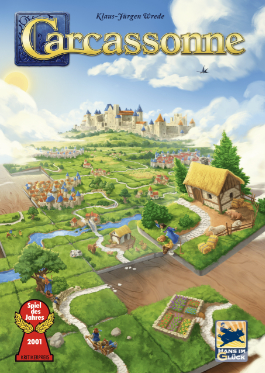
Analysis of the board game Carcassonne
|
The main assignment here was to play the game together with a group to later on analyze the mechanics and assemble it all together in this report. My group contained of seven people and we chose to try this game as it was said to be one easiest one to understand and to play, comparing to the other games we looked at. Carcassonne is a turn based board game where players compete against each other in order to complete lands with the help of different tiles (game board tiles, a brick to build roads, cities etc.). Each player builds the map with the help of randomly picked tiles to complete parts of the world and try to gather as much points as they can. To receive points a player have to place a piece (or a “follower”) strategically on a tile and depending on where one places his follower would determine how much points the player would receive after completing a “road” or a castle”. Placing a follower in a city makes it a “rider”. Placing a follower on a road makes it a bandit, completing a road would also give the player standing on the road some points. You can also put farmers on the “grass” (green areas on a tile), these points will be counted at the end of the game, this is due to the reason that the players need to see how much land is completed around the “farmer” giving the player points for every completed road or castle. Placing a follower on a cloister tile will make it a monk. Carcassonne is a game of a lot of risk and reward, where you may have to share lands to complete your own tiles, the tiles can’t be put everywhere either, every tile has to have the correspondent land, road or city to fit. Gameplay The game contains 72 tiles total, and all the tiles are face down and shuffled over the table, one tile will start the game and contain a single terrain (this one starts face up). For every turn a player picks up a face down tile and places it in a way where it has to connect together with the other tiles. Connecting roads together, cities to cities and fields to fields. For every new tile placed, a player can add a follower to claim any points if it connects to others and gets completed, but at the same time these tiles can be shared if another player has put their follower in the same “feature”. The game ends when the last tile has been placed, all the tiles with the followers will be counted and given a score for it, the player with the most score wins the game. The points will be different during game play and at the end game. There is also some tiles that has a “Shield” icon on them (I believe they call them pennants) where a player can get extra points from. The only followers that don’t get their points counted are the farmers, where their points get counted when the game ends. Every point received will be counted on a separate game board. For every city completed during play you get two points per tile + two points per pennant, at game end you get only one point per tile + one point per pennant. For every road tile you get one point, the Cloisters give you one point + one point for each of the surrounding tiles, max point for a cloister would be a total of nine points. Best sides The game is not as advanced as it would seem, it’s pretty easy to learn. It promotes social interactions between players, discussing what would be the best move to make, scheming and planning. Starting a new game would not be repetitive as the map would always be randomized, where the player chooses how to build the board, depending on what kind of tile the player picks up. The freedom of choice; You can choose how you want to build, the different variations often turns to new possibilities and opportunities which one has to take advantage of. The excitement; The hope for the right tile to show up in order to complete the area that is being worked on, and the hope that your opponents don’t gain that tile brings excitement. The creation of new roads and cities are to be considered artistic. Hard to win big, the winner will not be announced until the end of the game, showing the player progression, and there will not be a looser until the very end (in other words; no one dies). Bad sides The game should have a timer as some players tend to take far more time than needed and thus turning the board game into a bore game. With the help of a timer each player should be given a set time limit so that the game can proceed without delay. The name of the board game does not tell us anything about the game, also a difficult name to remember. I took it upon me to research the name just to get a better understanding of the creators idea, it turned out that it was named after the city of Carcassonne in south of France “famed for its city walls”. This would still not help me to remember the name of the game, if I would have wanted to recommend it to a friend. If the name was chosen for the medieval castle there this would be a bit far-fetched. In my opinion there are a lot more popular names one could have used for this board game, but I guess that this could be up to discussion. Target group The target group is 8+, at first it looked like a children’s game but after playing for a while one could understand that it would need some planning and understanding of the rules. The good thing about this game is that anyone can play it, if playing with family and having younger players, you can help them out but at the same time not risking your own gameplay. In Carcassonne it’s also pretty difficult to win big as every player will gather their own score. Out of the five rounds we played the difference in score wasn’t that great, even if we had people that had past experience with the game. Conclusion The most interesting function in this game would be the establishment and sabotage, at the first game rounds where we needed to learn the rules and understand the mechanics everything started out friendly, putting tiles together and claiming territories without any bigger conflicts made the game a bit easy going, but as soon as people started to settle in with the rules everything started to change. Careful planning and discrete takeovers was a game changer, it wasn’t that friendly anymore, but it also brought a lot of laughter when others did not manage to gather the points intended. After playing the game I can now strongly recommend Carcassonne to my peers, the combination of the rules, the map building with the help of tiles is something out of the ordinary. A joyful experience for someone like me that have not played these kinds of board games (I have mostly been playing Backgammon) and was not fond of them before. The thing that intrigued me the most was the tile design for this game, the way that these 72 tiles have been put together to make it possible for players to build different maps for every new game they start, never make it feel repetitive and always gives the player a randomized map and forces the player to come up with new strategies to try get the highest score and win the game. Playing these rounds and also observing the others play (as we could only play five players at a time), I was thinking of new possibilities to gather more points and playing it safe. I managed to see that in this game one can try to be manipulative and lure the players to make certain moves with some good arguments. But that would also be a difficult thing to do as the others would call out your bluff (or scheme). Playing with people that have played this before I managed to pick up some moves they made during the game, picking up a tile you could not use for your own gain left the option to instead sabotage for the other players by placing your tile in a way that your opponent would not be able to finish his city etc. Even though the tiles are randomized it does not change the fact that one can memorize the tiles, this can turn out to be to your advantage, but mostly only at late game, if you are close to complete a city and you know that there are a small chance for you to complete it, then you should go for a more safe option and try to gather your last points in a different way, even though they are single points. At the last game rounds we played, we added the river expansion to the game, just to try it out. This did not add that much extra to the game, I think that this expansion made insignificant differences, as it mostly provided with a few extra tiles of land. So for the expansion part I did not see it as something necessary to add to the game. Time limit is something that should be added to the game, as I grew tired of waiting for other players to make a move, waiting for them to decide where to place their tile made me impatient and in the end I just wanted it to be over. Something I think that one can add to the game or buy, is an hour glass as an extra feature to the game. With that you could shorten a game by a lot and avoid players getting bored in the process. Playing this game several times gives you the possibilities to think and rethink, this is a good thing as it opens the mind and teaches you to quickly rethink every strategy you had so far and come up with a new one. Concluding this report I would like to say that this was a nice experience and also an amusing gameplay.
|