Game Design Week 7 – Player Feedback
|
During our development process of Depth, two play testing sessions have been organized for all students partaking in the course, the first one was held after the alpha deadline, and the second one after the beta deadline. The purpose of these sessions was to provide a space for us novice game developers to see our games in action in the hands of a larger crowd. In advance, groups usually prepare questionnaires for testers to fill out to evaluate certain aspects of their games, but some of the most valuable feedback comes from observing the people who interact with the game. For our group this meant having at least one person – preferably two – stationed at the computers, where one person took notes of the things they observed and felt was important to improve/fix. Usually for us the major issues became apparent after a short amount of time, since it is a short game and most testers would get the full experience every time and thus see all the bugs. We also made note of the overall tester experience, so if the game was too hard/easy, if it aligned with our aesthetic goal, or other easy tweaks we could make to improve user experience. The questionnaire we made served to collect quantitative data on experience, since feelings are subjective and harder to draw general conclusions about without stats.
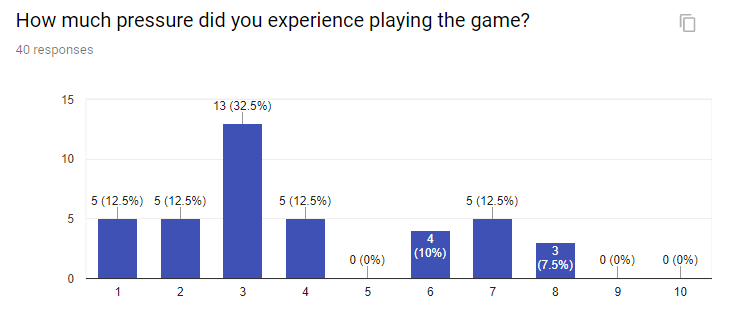
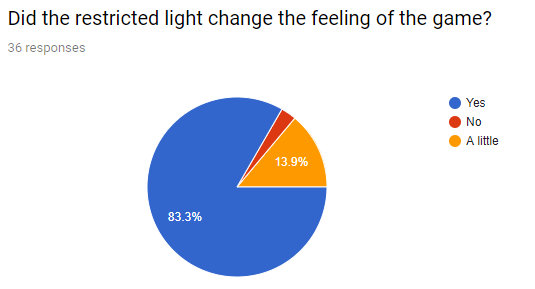
We got 40 and 36 responses respectively for the alpha and beta testing, which is a fair number to base game changes on, especially so for the size of the game.
The conclusions we drew from these play testing sessions and the changes we implemented were mostly regarding game difficulty and pressure. I think this is the most common/important part of feedback from playtesters, since it is hard to play your own game and stay objective. As a developer, everything is known and nothing is new, making the game feel substantially easier than it might be perceived as by an audience. In our case for the first session the opposite proved true; on average testers felt underwhelmed when it came to challenge and/or pressure. It seemed that we had over-compensated for our own skill when balancing the game, but also learning how to perform well in our game went fast, meaning players quickly were not challenged when navigating the underwater tunnel. As a team we discussed the outcomes of the testing sessions and based balancing and bug fixes on this.  |