Using data to improve Gameplay
|
There have been two official playtests conducted at Uppsala University Campus Gotland for this course of Game Design 2. We have used these playtesting opportunities to great effect, and the tools that have aided us most is the fundamentals that we were taught early in the course. Using the MDA we have throughout the project tried to keep our eyes focused on our Aesthetic goals. These goals define the feelings and the experiences we want the player to have while playing our game. For the project these goals have included:
As described in the Concept Document authored by team Poltergeist. When the team has lost the way and has been struggling with how to balance the mechanics, we have always gone back to look at these aesthetic goals in the context of what the game was supposed to be. During the play testing we collected data from the players describing their behavior during gameplay, as well as let them fill out a survey so they themselves could describe what they enjoyed or did not enjoy from the game.
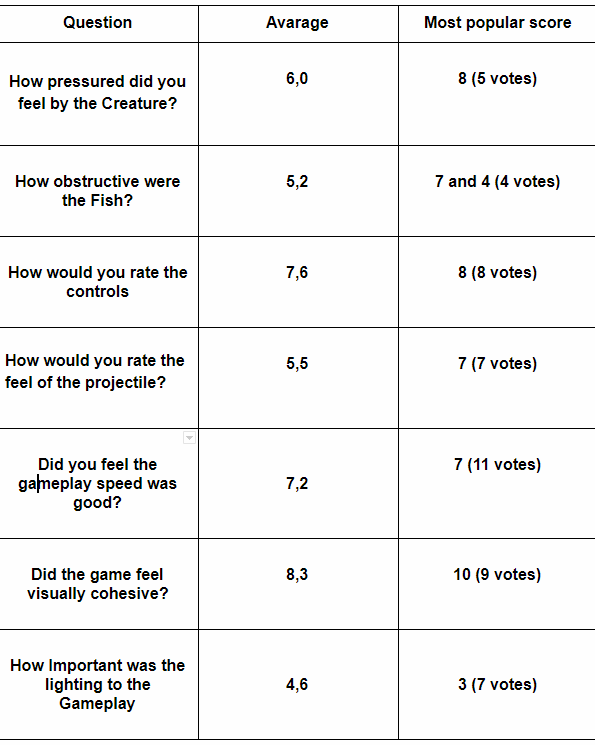
These were the results we got from the Alpha survey. Most notably the feel of shooting the projectile has a low score, as well as the average for the monster pressure. This data told us that told us that there was something wrong with the balance of the game, and it wasn’t related to the gun feeling overpowered. Feedback and visual analysis of the game-play showed that many players found the level too easy. This was the opposite of what our Aesthetic goals were aiming for. This was rectified in the next play test, where we exposed players to a more difficult level. We also made the movement of the Monster quicker, so that players rarely escaped it for long before it showed it’s head again, causing distress. We used the same questions to the last survey for certain aspects of the game we wanted to gather comparable data with, and saw a big increase in the feel of pressure from the monster. We tweaked the mechanics of both the monster and the level (in it’s design), we changed their dynamics with the player character, and in the end course-corrected to our desired gameplay aesthetic. In the end we found a lot of the feedback valuable, and made several changes to the controls, movement, shooting mechanic as well as hitboxes based on the data collected. Playtesting for us has been key in the iterative process of making a quality product, and I doubt the game would be any good without it.
-Benjamin Thomas Harbakk  |