Insight #1 – Setting the Scene
|
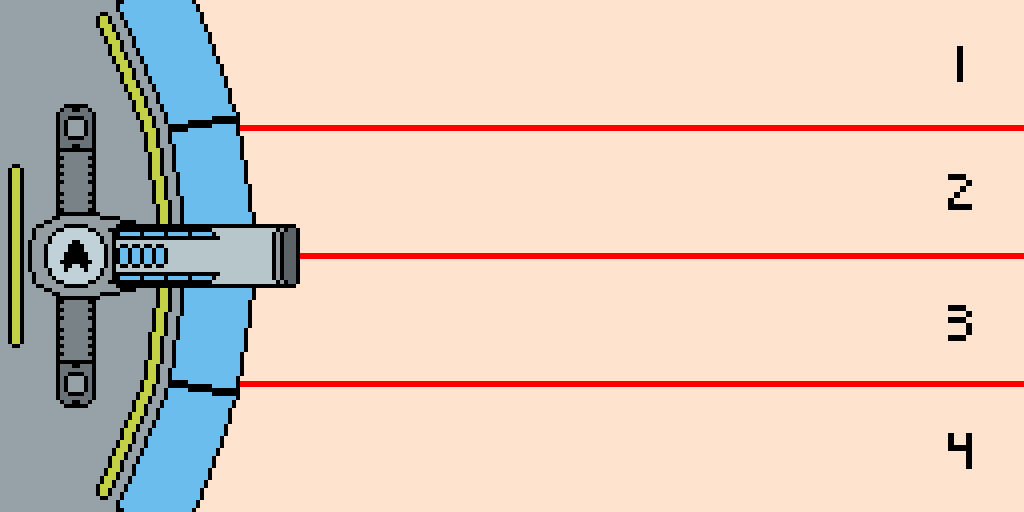
The original design document for Behemoth presented a simple yet challenging concept: “Feel like you are controlling heavy machinery”. This premise shaped how we approached the design and overall aesthetic of the game we are making, all the way from input controls to how the game looks and presents itself to the player. In this entry I will explain the thought process behind the layout of the game and what we try to convey with it. One of the core elements of the Behemoth concept is that the player controls a large ship, and to add to the mechanical feeling one does not affect the ship’s movement, but instead takes control of its offensive and defensive capabilities. Therefore, the first change we made with respect to the original concept was to change how the cannon and shields work. If the feeling of tactically positioning elements and controlling through precise inputs was to be fulfilled we needed to thoroughly think about our input methods, this led to the decision to use keyboard controls only, as a mouse felt too quick and it would feel awkward if the cannon lagged behind trying to force a slower pace. To have the player be able to feel in control of an apparently overwhelming situation we divided the playfield into segments, having the enemies move towards the player along these invisible highways.
We went back and forth considering the design and gameplay implications of different amounts of lanes. The 4 lane design was chosen to keep a clean and simple layout, one that could easily be understood at a glance thanks to the size and positioning of the shields and the movement of the cannon, which can be placed between lanes and turned to target enemies on adjacent lanes in an angle. The enemies appear from the right side of the screen and move towards the left side, rarely (if ever) changing lanes, making use of orthogonal unit differentiation and animation principles to convey the difficulty of each lane at any given point. This creates the illusion of an attack front, while keeping the actual threats down to a few predictable paths determined by the level design in order to present a fair challenge that the player can learn and master over time.  |