Post #1 – Aiming the canon
|
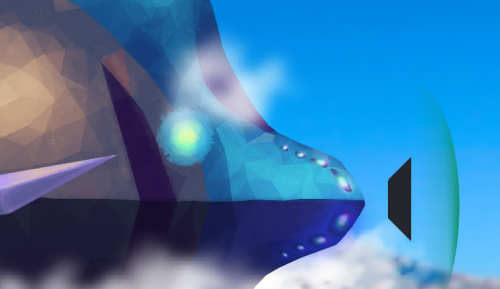
Who? Erik Rosenberg, I have been working as a project manager at a smaller media company prior to coming to Uppsala University, Campus Gotland where I am currently taking a bachelor of Game Design with a minor in Project Management. It is the second semester of my first year at the university. I am also a member of Group Siren (a group of students at Uppsala University, Campus Gotland). Said group is currently developing a game, Behemoth, based on a concept document made by Team Bugbear during the previous semester. What? A mouse controlled aiming function for the canon in the game Behemoth. The canon in question can be seen on the image below (the purple crystal on the left part of the image).
The game is being developed in Unity, a game engine using C# along with Unitys’ built-in libraries (pre-made functions written in C# specifically for Unity). What the function does is:
Why? As I am writing this post, we (Group Siren) have been conducting online playtesting for exactly one week, by posting a Unity WebGL-build on our group website: http://siren.erikrosenberg.se/playtesting/ In the first version we uploaded for playtesting the players controlled both the shield and canon solely using keyboard presses. A lot of the testers felt that they had to choose between protecting oneself using the shield or aiming the canon. This caused some to feel inadequate and appreciate the game less. As we try to use a player-centric approach which is understanding that the players are individuals who get emotionally connected to the game, and by extention, us as developers of said game (Adams, E. (2014) Fundamentals of game design, volume third edition. New Riders Publishing, p.81.) and use that as a basis to make informed design decisions, we have to make sure that our players do not feel inadequate. With this in mind we still wanted the canon to rotate slowly, to meet our aesthetical goal of feeling like you’re operating a heavy machine, hence the solution using the mouse. The reasoning being that the player would have more time to focus on controlling the shield while the canon is still moving slowly toward the mouse and in turn feeling like they are controlling both the shield and the canon at the same time, without actually doing it. Result A function that has, so far, received better feedback. Though as we are working iteratively and go over both internal and external feedback on a daily basis, as well as more in-depth during the sprint reviews it may still be subject to change.  |