Blog week #1

Herro! My name is Lukas Graff and I’m a 22 year old guy who studies Game design and graphics at Uppsala University – Campus Gotland. As a part of this course we are supposed to write a weekly post where we talk about our progress covering one artifact we’ve been working on during the week.
My project group is working on a concept called ”Mermaid River”, which is a 2D side scrolling space shooter.
Mermaid River is a game where you play as Captain Noleg – who is on the hunt after a mermaid who took all that Cpt. Noleg ever cared about, his treasure.
Equipped only with a harpoon and the oars that he use as legs (after experiencing an attack years ago he lost his both legs – whereas he had no better solution than using two broken oars as legs) the player is on the hunt as captain Noleg to bring back his stolen treasures.


This week I’ve been working on different things but with emphasis on the background for our game project.
Its been a pretty long and difficult process (covering more than one week), mostly because the lack of experience and routine.
My vision about how this was going to be executed has changed a lot since the beginning of the project. What was decided pretty quickly is that we wanted the background to be of parallax scrolling – which means that the background have different scrolling speeds depending on how far away the player is from the objects.
Objects close to the horizon will scroll much slower than the objects close to the player. This creates a stronger feeling of movement.

TEST red2

The big question has been to decide if the background is supposed to be divided in different tiles or if it should be a long loop of one big background.

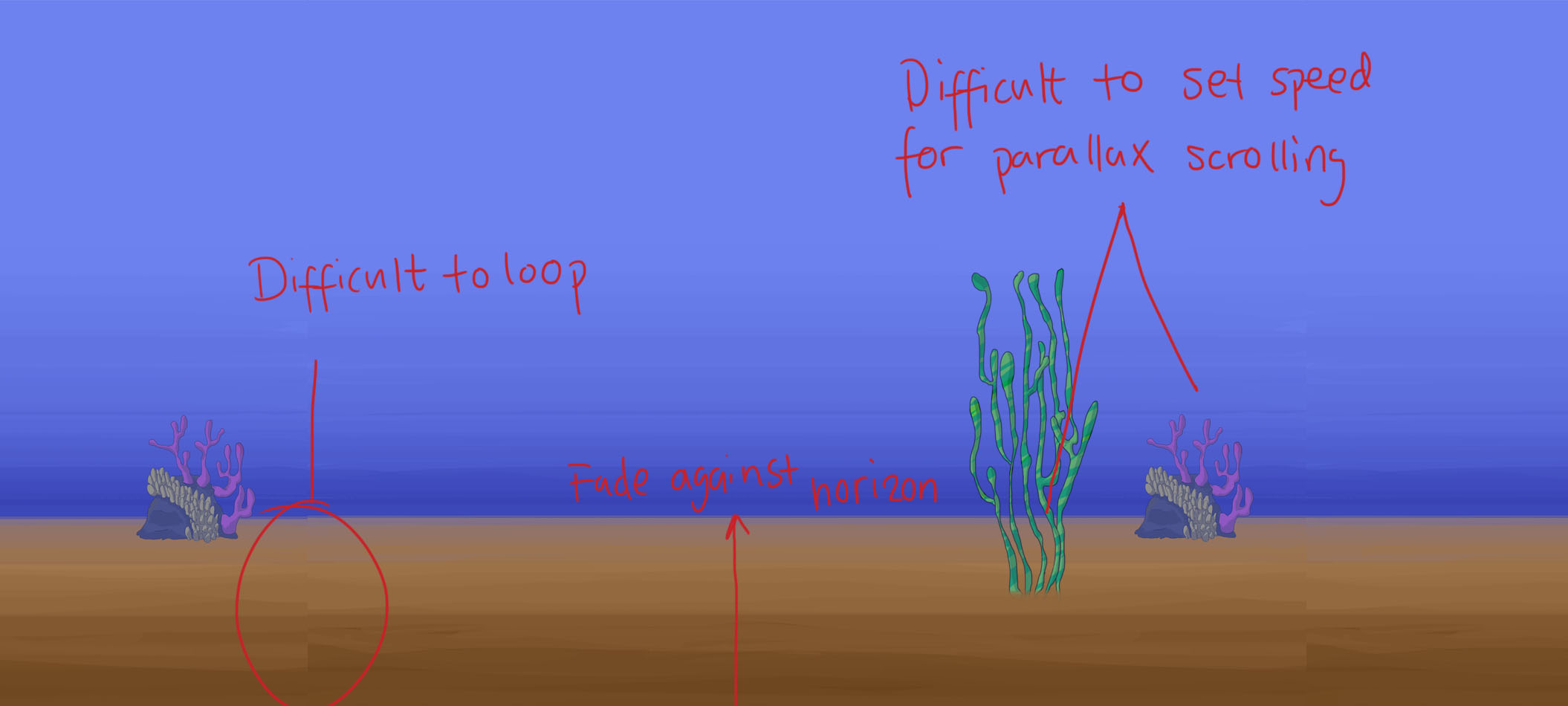
Struggles like how to render the sand to make it look representative and at the same time are able to be looped without giving the player a feeling of recurrence was a hard part. The first approach was to reflect depth in the background itself where the foreground was shaded in a way that it slowly disappeared at the horizon. After a few sketches (pic.1) this showed to be really hard when it comes to the looping part. Every single loop as well as object would need a lot of extra rendering when put together. It would also include that the parallax scrolling wouldn’t work the way we wanted.
background w tiles red2


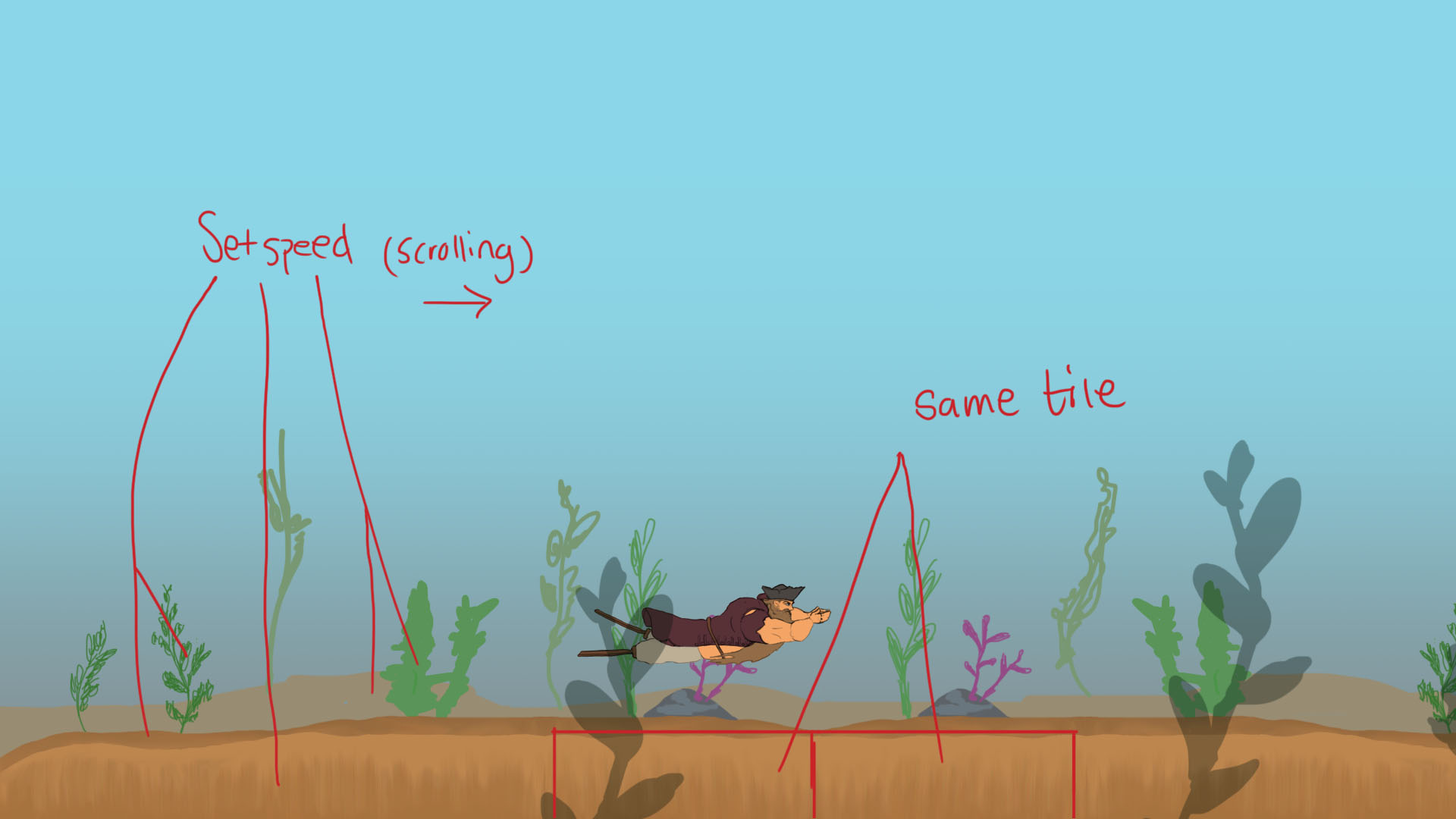
After a lot of research and sketches of different approaches we decided that the best way to execute the problem with depth in form of parallax scrolling was to remove the idea where the sand fades at the horizon and instead make the background directly from the side (pic.2). This would also make it easier to make loop able tiles as well as adding existing objects, like stones and seaweed without the feeling of repetition.
All the objects like corals, stones and seaweed was also very uncertain in the beginning but feels a lot clearer now when we have a better understanding how the tiles for the background will work out. The tile system will also make it easier to create the levels inside the game – since it won’t require as much extra rendering like showed in the first picture.

We will continue to go with this tile-approach and that we hopefully can test the parallax scrolling in-game before next week!


About Lukas Graff

2015 Graphics