Umibozu: a post mortem
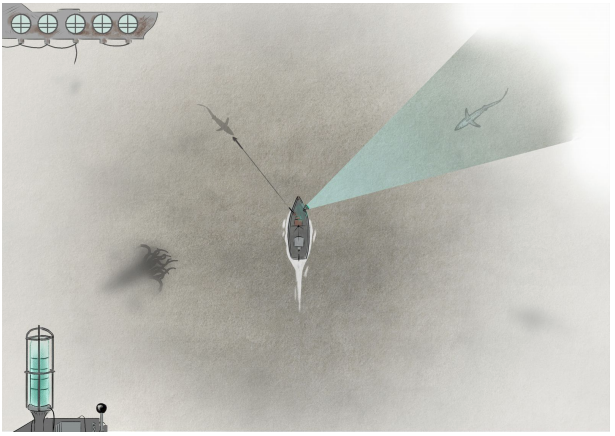
ContextFor a course, I worked a few weeks on a simple shoot them up game prototype in which you played a sailor lost in a haunted and misty sea, trying to navigate the dangerous reefs and avoid the attacks of the creature dwelling under the water. We had to design the protoptype from a concept document that outlined the core mechanics of the game and its general structure. We allowed ourselves several changes from the original concept document. We change the random fish ennemies for tendrils of the creature that haunted the sea, for aesthetic reasons; and we removed the different phase the game supposed to go through (exploration, boss fight, flight), for pacing. We did keep the top down view and the light cone to see through the mist. Here’s are some thought about the process of making that prototype.
A mock up from the concept document Aesthetics vs mechanicsThe concept document was about a game with an atmosphere of mystery and quiet dread, with the mechanics of a shooter. Early on we realized that these aesthetic goals were at odds with shooting waves of spawning ennemies, and we tried to find some way to work around it. We made the careful navigation between the reefs the core obstacle that the player would meet, to try to direct the attention away from the shooting part. All ancillary mechanics were about either avoiding ennemies or assisting the player in his navigation. In the end we even removed the ability to shoot back at the ennemis, focusing on evasion and trying to lean into the aesthetics of the concept document. The elephant in the roomWe spend almost all of development time going back and forth on the fog mechanic. Initially we had some rocks hidden by it, then only the ennemies; we had the light spinning automatically, then let the player direct it; we tied a ressource to the light, then made it unlimited; had a small circle of visibilty around the boat. We tried all permutation of the ideas present in the concept document, but it would never click together into something satisfying. It’s only in retrospect that I realized something that should have been obvious : fog as a hazard in a top down 2d game is simply nonsensical. All 2d games with a top down view have fog, because the borders of the screen are mechanically equivalent to it. Had we realized this sooner, we would have had the mist fulfill a completely different role that hampering the player’s view. ConclusionOne of the biggest factor that prevented our prototype from coming together was probably that we took the concept document for granted. Without the willingness to break from it, we designed ourselves into corner after corner. This exercice was a good illustration of how the MDA framework can help us. The Aesthetics, dynamics, mechanics trio can help us break down a game into its components, but more importantly, it should make us reflect on whether or not these components belong together.  |