|
Ten weeks of production and development have come to an end and after a few days of digesting the last workload-heavy week, it is now time to look back and reflect upon this great experience. This entry will also close out this blog series about the making off Umibōzu, a game based on a concept designed by Team Gnoll.
Umi.. what?
The spirit of the Umibōzu originates from Japanese folklore. It is said to be accompanied by strange ocean phenomenon. It has been described as a hostile spirit, destroying any ship that dares to cross its path. The few that have seen the Umibōzu are usually the sole survivors of the ship that encountered it.
Explore uncharted waters on a quest to find the legendary Umibōzu. Armed with a harpoon and a spotlight to provide better vision in the thick fog that surrounds your ship, you must navigate perilous waters. Only one motivation drives you. Is the story of Umibōzu just a tale told by drunk old fools in mourdly bars or is there any truth to the tale?
The player is steering their fishing boat through a mysterious and endless sea, passing landmarks on the way that each reveal a part of the story of Umibōzu. The water is shallow, the air filled with mist and Umibōzu omnipresent, requiring the player to make good use out of his light, his lures and his navigation skills.
What went right?
Unique interpretation of the concept
Contrary to other groups, we as a group decided to not go with the generic shoot-at-shadows type of enemies, but instead we actually have the Umibōzu as an omnipresent creature in our game, that, albeit abstracted to a kraken-like creature, constantly appears throughout the game. Umibōzu is a constant threat to the player throughout the entire game, even though its occurancy and intensity of its attacks progress throughout the game. We decided to not give the player character a harpoon, rather we wanted to focus on creating a mysterious and exciting experience and journey for the player. Umibōzu isn’t about combat afterall.
Furthermore, we implemented a compass and four landmarks to which the compass guides the player, adding some kind of narrative and story to the game. The compass later became a feature in a lot of other Umibōzu games as well, since it probably fits the concept well in general, but I think that we did the best job of giving it a good use. We also have a unique pick-up, which is a lure that takes aggro from the enemies in contrast to generic power-ups like „longer battery life“ or „wider light-cone“.
Key aesthetic of Umibōzu:
The feeling of approaching something mysterious and exciting, having it feel unpredictable but not unfair, having the player feel like they are in a constant moderate level of danger while not stressing them out
Even though we iterated and strayed away quite a bit from the original concept, we are confident that we conveyed the aesthetic we aimed for really well.
I am happy that our game stands out from the mass and we have received a lot of positive feedback because of that. It was definitely a bold move to change that much in comparison to the original concept, but I am glad that we have taken that step.
Art Style
Overall I am contented with the quality of my art assets, or at least the ones that are implemented. In particular, I am proud of how the enemies shaped out and I think they look really amazing. Having our game often described as artsy or as beautiful, visual experience is obiviously a great confirmation that we have done a good job.

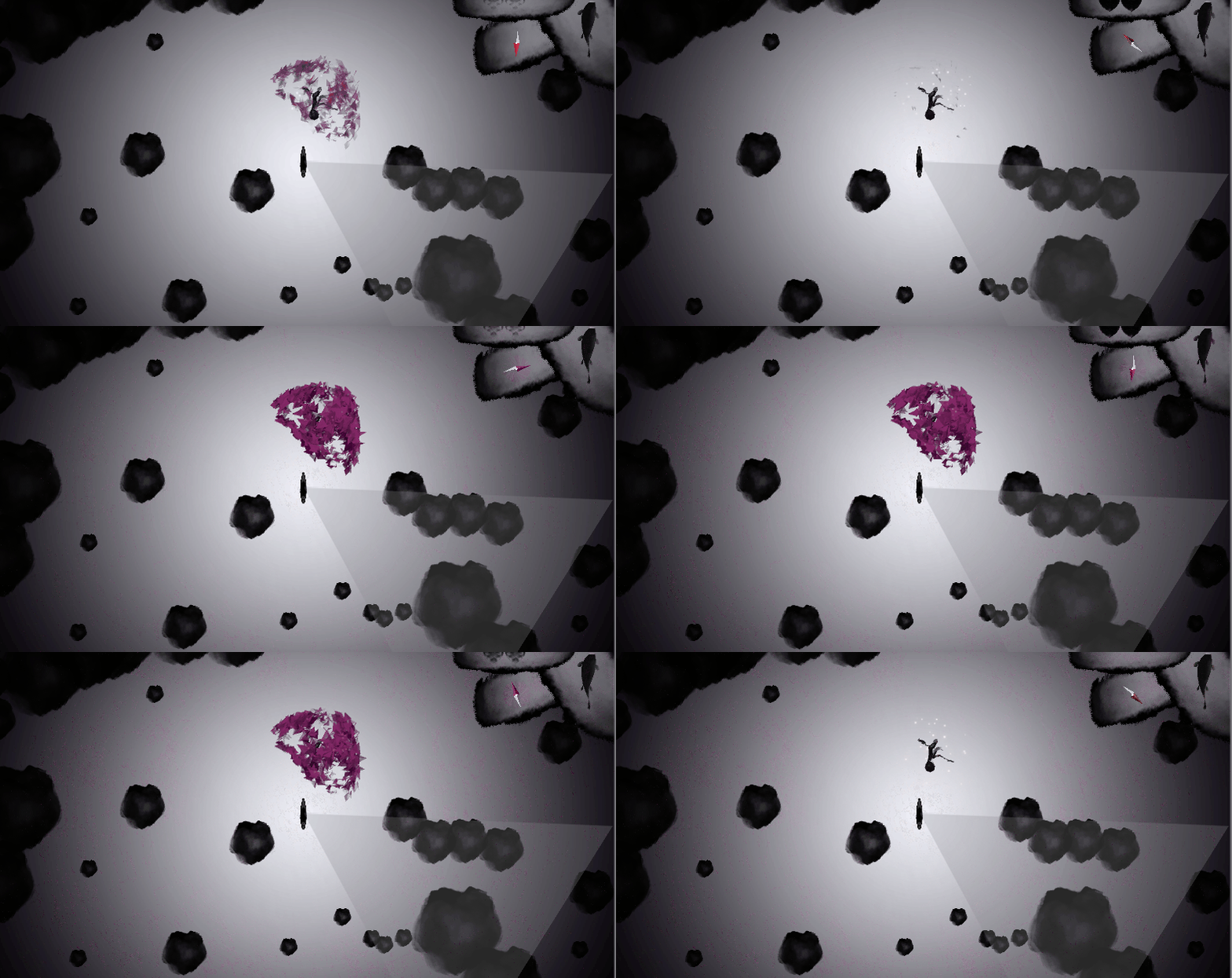
In-game footage of our game Umibozu
Self made 3D model and rig of three types of tentacles (we didn’t use the asset store unlike other teams :)) , applied with a custom fluid-looking ink shader. Splash animation pre-rendered in After Effects and also shader applied in Unity.
Great personal learning experience
While I have worked with Unity before, it was a great opportunity to not only further improve my skills in Unity and its particle engine, but also in Adobe After Effects, Photoshop and Blender. I soaked up a lot of guides and tutorials and experimented a lot, which was really fun to do and I am confident that I gained a lot of new, valuable knowledge that can be applied for upcoming projects.
What went wrong?
Playtesting
Playtesting was a big issue for our team. While we had three playtests in theory, we had a lot of issues and complications during all of them and I am convinced that our game suffered A LOT because of that. We weren’t able to gather enough feedback and it is kind of disheartening to see that we weren’t even able to present our final version of our game.
Motivation
I have to be fair and self-critic here and mention that I have experienced some motivation issues during the mid-stage of the project. While the concept of Umibōzu sounded good at first, it turned out to be rather dull and one-dimensional and I kind of lost interest in the concept, which resulted in me not giving my best at every point of time.
Bad Game Design
Before we completely revamped the level design last friday, our game design was, hands down, shit and there is no real excuse for it. The game was too hard to play, the player was left in confusion because we didn’t introduce them to the game concept or its elements in any good way and the level design was plain awful. In the original concept, you are able to shoot at enemies (silhouettes) with your harpoon, but we all agreed upon removing this feature because it was too linear, contradicted with our theme and just not „fun“ to play. While we do have an enemy that shoots an ink projectile, I would not classify this game as a shoot-em ‚up game, so we kind of failed in that regard since it was part of the framework for this project. I personally was not that involved much in the actual design process since I was too busy with the art, but Game Design is my major – so I should have been.
How could this have been prevented?
- better time management (less crunch before important deadlines)
- Ensuring work has been done, instead of just taken the word
- Working physically together is g r e a t ! We should have done that more often (we did 70% of the last two sprints in 2 days while we were working together). It just boosts the productivity and you can first-hand see what people are working on at the moment and you can get a lot of inspiration and internal feedback. It also makes the project more cohesive and prevents having four different Umibōzu games in the end.
Final words
All in all, this project has definitely been a great learning experience and I was definitely able to broaden my horizon and gather a lot of new knowledge in- and outside of the course content. The project has had its up’s and down’s, but I am more motivated than ever regarding the upcoming arcade project!
Big thanks to my team mates Tim, Basil and Siri who accompanied me for the last six months and with whom I have worked together on this project. Check out their blogs if you want to read about their perspective!
About Alexander Sinn
2017 Graphics
|
