Prototyping, testing, and play testing
|
Each of them has the same goal but different purpose – game prototyping, software testing, and play testing are important processes during digital game development as they all improve quality of the game product. Prototyping helps game designers to validate ideas and concepts, whereas software testing helps developers to detect errors and bugs in codes. Usually, prototyping and software testing are conducted frequently by internal members of the development team, i.e. designers, developers, and artists. Play testing is a process when the developers provide testing versions of the game to test players, people which are not part of the development team. One may rise a question, “Why to provide play testing to outsiders when the product is not done yet?”. And there are many good reasons to do it. For example, to avoid confirmation bias or observer-expectancy effect in testing. Although some development teams validate prototypes often and do testing frequently, when do tests manually they cannot avoid biases, because testers are part of the development process. Sometimes, designers, coders or graphics artists are prone to ignore some odd features, errors, or bugs in their games, in a similar way, as mothers are unreasonably proud of their own children, even they might know their weaknesses. Caused by love, sentiment, or nostalgia, romantic ignorance might be considered as virtue, but during game testing the lack of critical thinking has no place. To avoid bias, invitation of independent test players can be a welcomed solution, because test players are authentic, critical, and independent. Test players can find errors and bugs that were not discovered by team before. They can point out which game play modes work well and which do not work at all. Moreover, play testing conducted by independent test players may reveal new or hidden aspects of the game, that were not intended in game design at all. In some cases, play testing might even re-shape the design or change the direction of the development and final product.
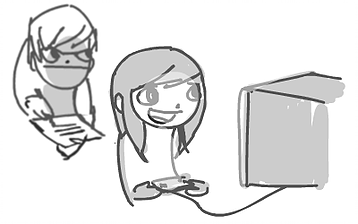
Play testing are provided to test players. When playing the game, they generate extremely valuable feedback data that can be used later to improve the game. A play testing session must be prepared by game designers carefully, and results from the session should be reflected critically to ensure the game development is on track. The feedback data can be collected by variety of ways, e.g. questioning test players after a game play, direct observing of the test players, recording their inputs, screens, face expressions, body movements, or any other players’ behaviors during or sometimes also after the game play. After the session is done, the collected feedback data are analyzed and reflected by the team. Play testing can be time expensive activity, thus must be conducted effectively. Depends on the purposes of the play testing, play testing sessions can be held remotely on-line/off-line or on-site. Test players invited to play testing can be target audience sample, game journalist, or any other focus group. In case of the student projects, test players were game design students and teachers invited to play testing the student group games on-site. To overview the play testing in my group, we conducted a qualitative survey to collect and analyse feedback data from the test players, consisted of records from direct observation and questionnaires Each test player was asked to play a given version of the game, and to fill a given questionnaire after the game play. During a game play, the test player was under direct observation by observer that transcribed his real-time observation in a form of manuscript records. In total, we arranged 3 play testing sessions within 10 weeks: pre-alpha, pre-beta, and final. We collected and qualitatively analyzed feedback data counting more than 600 records, involved roughly 100 test players, i.e. 33 test players per each play testing in average. Feedback data from manuscripts and questionnaire were analyzed using qualitative approach, and reflected by the group in the next two sprint plans following the play test session, thus the feedback data from the play testing re-shaped the final game product.  |