2018.03.08 – Playtesting Aesthetics V.S. Narrative Design and 3rd-party I.P.
|
Game concept overview Our team had chosen a concept titled “You May Kiss the Bride” where the character got cold feet the day before the wedding. The player would then take over the commitment-phobic character and be thrown into a a nightmare. There s/he is trying to escape the commitment they were about to undertake with their significant other by running away from it just before they did their vows and making their way to the church’s exit while fighting their way through a wave of wedding guests who have now turned into hellish monsters.  We had interpreted the core “stress” aesthetic as one arising from the human nature of getting scared when committing to life-changing events – a wedding being arguably one such possible moment. Since we considered ourselves being a production group in this scenario working with a 3rd party I.P., we decided to focus on implementing the game design as portrayed by the group who originally made the concept. We were also encouraged by the faculty to only change elements of the concept if they negatively impacted the gameplay itself and we could justify such a change bringing extra value to the end-user, i.e. the player. What were we testing forBased on the overarching aesthetic goals, our focus was to check during the playtest whether we had implemented the mechanics as envisioned through the M.D.A. framework where leading to the “stress” and “constant threat” aesthetics. Playtesting – a feedback overview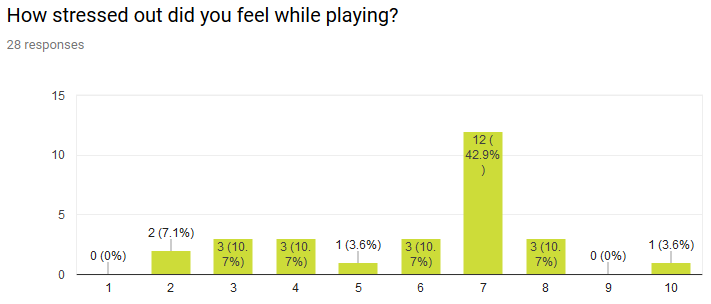 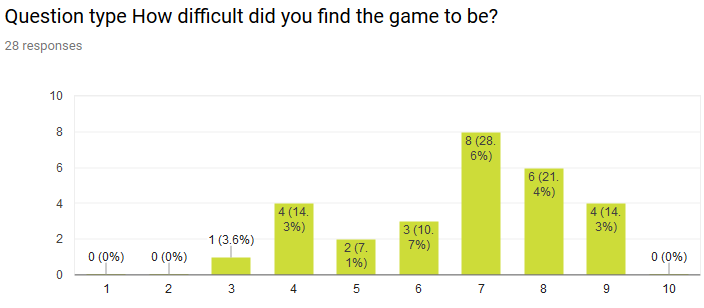 Our test sample included 28 playtesters, all of which were students in our GAME department – including the team who originally designed the concept. Based on the results we got, our team concluded that the general implementation of the mechanics had been in-line with the aesthetic goals outlined in the concept document. As such we filed that in the success category, while keeping in mind that we still had to fine-tune the game balance for two reasons:
That being said, the most valuable piece of feedback we got came seemingly out of nowhere and concerned the narrative experience rather than the execution of the concept itself. Gameplay design vs Narrative designLet me preface this coming paragraph by saying this: As mentioned earlier, our team looked at the core “stress” aesthetics from a commitment-phobic perspective. Why? Because half of our group is looking forward to getting married while the other half is not quite so keen on it ^^. As such we considered the general concept to be fine and the gameplay design to reflect it appropriately. Transmitting the commitment-phobic narrative through gameplay has been our biggest struggle, and thus we asked a member of faculty after they finished testing our game. There was some reticence at first but we eventually got a very direct question in return: The answer was pretty simple in our opinion; the game concept had portrayed it that way and we were running out of time to produce the male versions of the NPCs which were only appearing later in the level. Since that whole part was unfortunately cut, this was the result. After some further discussing and digging, it eventually became clear that the issued lied in our interpretation of the game elements. => As a group we had been focusing on executing the aesthetic design’s intent the way we understood it and we therefore never questioned the bigger picture. A perspective that hadn’t even crossed our mind until that point. Separating the opinion from the core criticismThis interpretation came as somewhat of shock to us. It was a shock, not because of the justification, but rather because we agreed on the core point it was making; namely: unconsciously presenting an all female-devilish monster cast of enemies in a very tradition heteronorm setting (a wedding between a man and a women taking place at a church, where the man is the one taking action against them). While that part was taken in by all group members, a lot of us tuned out as soon as we were asked whether we were an all male group. “Oh, how typical” you may say. Criticism, even constructive one, is hard to take – even more so when it relates to a creative product you have been working on. Personally, I believe anyone could have made that mistake – especially this early in their game design career/studies. The problem of this otherwise invaluable feedback is that the justification felt subjective rather than objective, and thus muddled the water making it more difficult to identify the underlying core issue at hand. Ultimately we are here to learn, evolve and become more aware of these issues. As such it was important to distance ourselves from the product, the critique and re-evaluate the game’s narrative through that lens; regardless of what had been planned and/or needed to be cut. “But why?” you ask, “it is not our fault what people may or may not interpret into another-wise neutral vision!” you might think. The reason is twofold: On one hand after all is said and done, the player will only see the final product, and not know of our original intend or vision; on the other hand, as story tells we are responsible for the use we make of our medium (in our case games). Taking C.C. (constructive criticism/critique) and iterating on itIn the creative industry more so than in any other, we tend to put in a piece of our soul into whatever project we are working on. As such, it becomes inherently hard to not take criticism on the product personally. It is, however, vital to take in C.C. and iterate on it because in the end we are delivering a product FOR A WIDER AUDIENCE, NOT US!!! So what can you do to be more receptive to it? When analyzing the validity of C.C. it is key to keep in mind that it is about the product and not you. C.C. is meant to help improve the final product for your target audience and is completely different from somebody simply given their opinion on it. (see the Oxford dictionary for more information on critique vs opinion). How did this specific critique impact the narrativeBased on the insight we received on how our narrative and overall character design may be interpreted, our group got together to discuss how the narrative framework could be reworked within the remaining time we had at our disposal to deliver the game. 1. Inverting the genders = rape game or stereotypical women “weakness”
So that was non-starter. 2. Implementing the choice of character gender Therefore this option is also out-of-reach in our current situation. 3. Changing the sexuality of the protagonist to turn it into a societal critique This would require some changes on how the final cut-scene is presented. Fortunately this one has not been made yet and therefore this change would not involve reworking assets. However, this puts us in a position where we are assuming something about another group of people that no-one in our group of hetero-sexual white men belong to. We would need feedback from that community on whether this would realistic portrayal of an existing issue. 4. Stand by our mistake and face potential player backlash Which ever option we decide to go with, this has been a teachable experience for all of us. We lived, we learned, we improved … but! …While I believe that our group has grown as a result of the feedback regarding the possible narrative interpretations, I feel the way how the critique was provided can have potential undesired side-effects. The main one being: students avoiding any sort of sensitive subject in their game consequently limiting the development of games as a medium – especially to treat topics such as for example diversity, social inequalities or parts of our history like the holocaust. This would also limit their creativity and the game produce within the framework of the university. That being said, I do not know of an alternative way to provide critique to students that would not have this side-effect. TL;DR:Making games is hard, telling stories in games and seeing all possible issues with it is even harder x’-) Therefore external playtest and critique is crucial for us to become better game designers, and help the medium evolve in a responsible manner. Take critique to heart and learn how to differentiate between actual issues, people’s opinion and recommendations that -while valid- aren’t in-line with your aesthetic goal. And finally, as a production team you will still be held responsible for problematic design decisions made by whomever you got the original I.P. from; so chose wisely and make sure you can stand behind the concept you are realizing. To be continued in the up-coming postmortem post where I will present the solution we went with.  |