Scrum and the Daily Stand Up
|
Scrum is one of many approaches to agile development. All agile approaches have in common that the solution is developed iteratively and released in increments. Agile approaches build on the four pillars of agile as outlined in the Agile Manifesto. 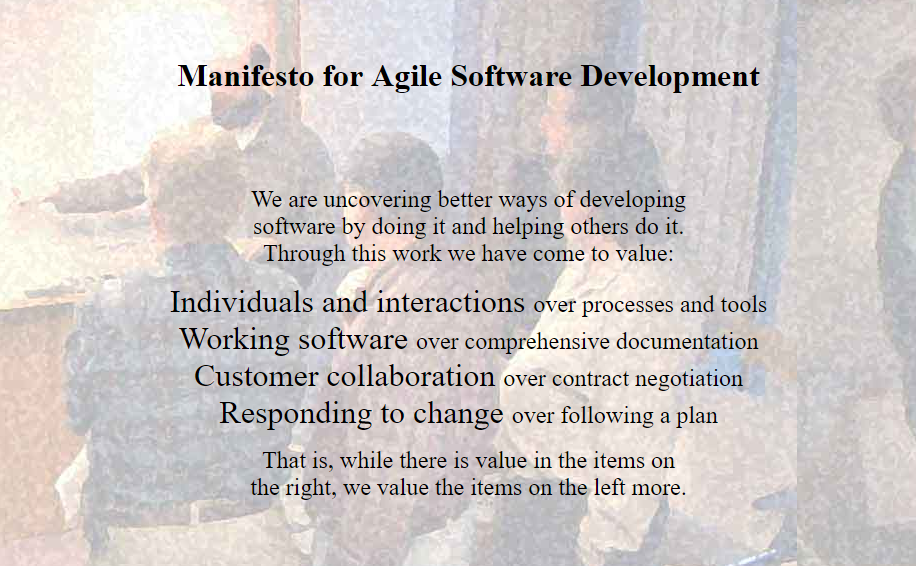 Scrum offers a framework in which teams that adhere to the agile philosophy can work productively. The development iterations in Scrum are called sprints and can each be one to four weeks long. The work is planned on a high level (not very detailed) at the start of the project and only the tasks the team decides to tackle in the upcoming sprint are planned in detail. This allows teams to react to change quickly and to adjust their work if necessary. For this to effectively happen, Scrum introduces three types of meetings the team needs to have. A sprint planning meeting, in which the team decides what to do in the next sprint and in which team members then plan those activities in detail. A sprint review meeting, in which the work of the last sprint is evaluated, and the newly gained experiences are discussed with the team. The sprint review is typically followed by a sprint retrospective, in which the team evaluates their way of working and discusses potential improvements of the workflow. Lastly, teams working with Scrum have daily stand ups, the function of which I want to explore further in this blogpost. The daily stand up is a short (10-15 minute) meeting which, as the name suggests, happens every work day. The team comes together and each member reports what they did yesterday and what they are working on today. The aspect of the daily stand up I want to focus on is the “reporting” done by each team member. Reporting is a one-way street. Information is reported from one person the other(s). This is not what the daily stand up is there for! Scrum (and any other agile approach for that matter) lives and dies by the people and their interactions applying it. The daily stand up should not consist out of reports, it should consist out of conversation and communication. As the project manager of my group, I have the role of the Scrum Master within Scrum, which means I am primarily a facilitator. Team members should not report to me. If they do this I facilitate my daily stand ups wrong. The daily stand up should serve as a platform where the team can coordinate their day’s work not as a tedious ritual that needs to be performed daily. In summary: Scrum wants team members to interact daily through the daily stand up. The purpose of the stand up is not to report to the project manager, producer, Scrum Master or other team members! The Scrum Master needs to facilitate the team’s interaction, she is not supposed to be reported to. This can be done by asking the team to give feedback to things another member has said and by trying to detect dependencies and conflicts that arose or will arise between team members work. If dependencies and conflicts are detected, the Scrum Master should steer the conversation to those issues and guide the team members in resolving them. With all of this in mind I want to end by arguing for an unpopular opinion when it comes to the daily stand up. If done by the book, the daily stand up should happen at the same place and time each work day. I think this is not important. It does not matter at all in my opinion where and when the daily stand up is done. It just matters, that it is done! This might be an issue unique to students, since people working full time are already in the same place at the same time anyways. I strongly belief that my duty as a project manager is first and foremost to create a working environment for the members of my team, that suits their individual needs. Dragging team members to university for 20 minutes each day, no matter their schedule is more destructive to the productivity and motivation of team members than having the daily stand up digitally (via VoIP). Whenever the schedule allows it we meet in person and we strive to do so as much as possible but in the digital age one can’t expect someone to commute for 40 minutes (20 there, 20 back) to a ten to 20-minute meeting. It must be said though, that this is only an option if the quality of the communication does not suffer when holding the meeting digitally! The group’s discussions during the daily stand up are to valuable and important to the group’s success to be compromised.  |