Post #3 – Scrum – How it has affected the project so far
|
Group Siren (the group I am a member of) has been working together since early last semester, though without applying a specific framework to our work-process. As we started working on Behemoth, which we are currently doing, we also started using Scrum as the framework for our project.
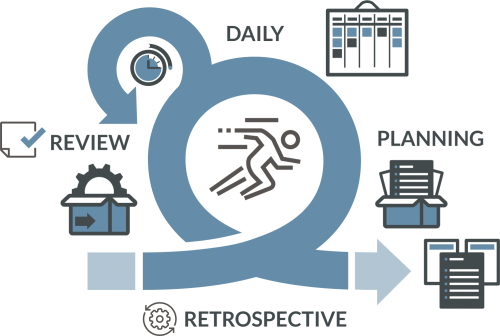
Scrum for dummies Scrum is an agile framework, based on the agile manifesto and can be summarised as an itterative development process, best applied when you have a rough idea of where you want to get but you are not sure how to get there. You start off by writing down all the features you want, when developing a game, examples features could be the player avatar and an enemy. You then give each feature artefacts, examples of artefacts for the aforementioned features could be health and player movement for the player avatar and health as well as enemy movement for the enemy. Once the team has written down every single feature and given each feature all the artefacts they can think of the team has a backlog. Once the backlog is completed you decide how long you want each iteration (or sprint) to be, in our case we chose 1 week for each sprint. In the begining of each sprint, you hold a sprint plan meeting, where the team members chose and commit to artefacts from the backlog that they want to complete during that iteration. During the iteration or sprint the team holds a daily stand-up meeting, going over what they all did the day before, what they are going to do today and if there is a problem that needs to be adressed or anything holding them back at the moment. At the end of the sprint the team holds a sprint review meeting, where they go over what has been done, if there is anything that a member commited to that was not completed and if so, why. Now the plan, sprint with daily stand-ups, review process is repeated until the project is completed or abandoned. Scrum with Sirens For Group Siren using scrum has been a major change, for the better. While it can be tiresome to walk down to campus and meet up the same time every day, it has provided good insight into what works for the group and what needed to be changed. A downside with the framework for our group is the fact that as the group consists of only 4 members, should one of us be unable to attend a sprint plan due to illness, 25% of the group is not attending and in turn, 25% of the group is unable to speak their mind when decisions for the week are made, which can hamper the efficiency of work being done for a day or two, which is a lot when you work with 1 week sprints. Examples Before we started using Scrum, we managed to complete all the tasks required in the course we took in a timely manner, though we did it with a lot less structure. Last semester, as we worked on the concept document Beezerker, without a designated framework we ended up working toward different goals for about two weeks, without anyone realizing. This forced us to remake perfectly good assets as they did not go well together. With daily standups and continuous quality assurance carried out by various team-members, especially team-members working on assets that were going to be merged with the asset they did QA on. This resulted in forcing away the vast majority of the miscommunication as assets were not approved unless the the asset was both a) consistent with the other assets and b) turned out the way everyone thought it was supposed to look. In addition, as we did QA, the need for design meetings prior to each sprint plan meeting became apparent to us, where we just discussed, sketched and paper-prototyped what we were talking about until there was little to no room for misinterpretation, this helped us a lot. All in all, scrum is working for us and I believe it will only get better the more we use it.  |