Week 3 of Big Game Project: Early UI and what to show the player.
|
Beyond more production and design work, migration of systems from the prototype to an early pre-alpha build began. Since systems were no longer being tested by internal testers, the game required an UI on both the server and client screens displaying statistics like player health, Initiative number and which attacks are selected. The transfer lead to the use of actual equipment to appear on the GGC floor where the UI appeared differently and would require different solutions.
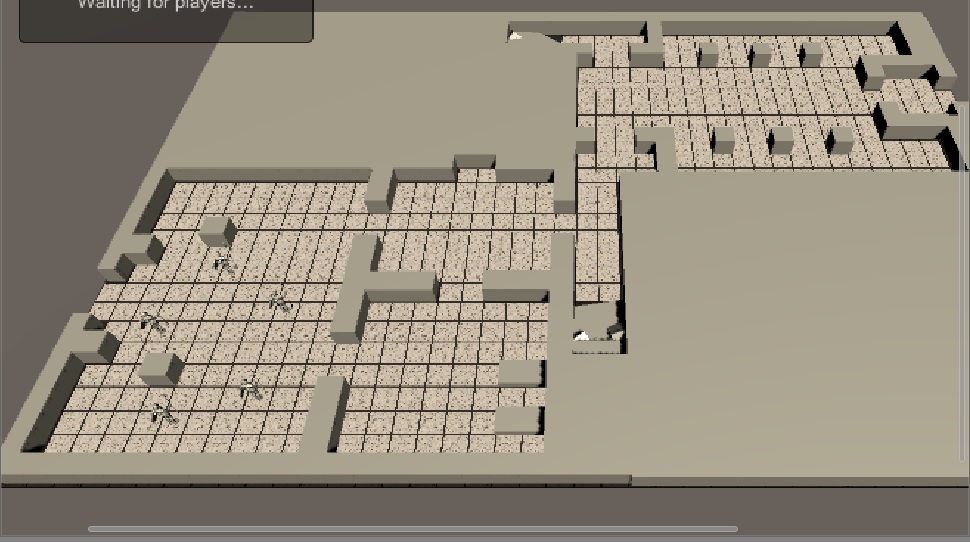
Above is one of the earliest Server images with actual placeholder art the group I was part of produced. It lacks almost all UI elements except for what we were testing at that very moment, namely connectivity. Players only needed to know if they were connected or not to show if the server would keep a stable connection and to test the new hardware our clients had similar designs. As the game was populated by player and enemy entities and they were allowed to commit to actions, decisions had to be made about what information to show and when. Not only because users require consistency and ease of use (https://www.interaction-design.org/literature/article/user-interface-design-guidelines-10-rules-of-thumb) but because our game was focused on betrayal and paranoia and hence as designers of the game, we did not wish to give away too much about player choices towards other players. Our first decision regarding this came in regards to initiative. In the first draft, each user could see other users choices as they happened, listing their initiative order as it was altered. However, players responded with irritation at not being able to hide their actions through such free information: If they could instead remove that ability from other players in some way, they were free to tell users they were doing one thing at one initiative step, but do another in the real player space once they committed to an action. This change was implemented and partially inspired by the Diplomacy game, a more text and speech-focused game played as much outside the game itself as within it. However, initiative order was still a useful tool to explain to players just what players did what and so the order was kept, except only updated post-turns. That is, after a turn was completed, the initiative order was displayed on the server screen to give a summary that players could scan to give them an indication of what sort of initiative they had left to choose and to determine if a user’s proposed actions were true to their words. At this stage, most UI elements on the Client side were related to movement, attacks and statistics the player could affect directly, whereas “passive” elements were kept to the server, such as timers, former turn information and enemy placement. TAGS: BGP, 5SD037  |