5SD033 Art Direction Alterations
|
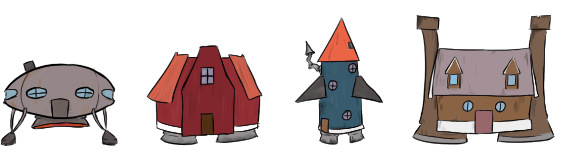
As this week was set aside for finishing up our game’s design document, updates on programming will come next week. This post however will focus on the decision of changing game art themes against initial suggestions by me as a programmer and designer, and some of our artists alike, to better fit the placement techniques and spawning of enemies within our game. Enemy design in the initial concept document we had inherited was sparse, in that the only examples of actual art of these was found on the game’s cover. This held a picture of a flying saucer from the sci-fi movies of the 50s and 60s, a spinning plate with colored lights. While distinguishable from the background, it was also generic in the sense that it is a design that has been re-used several times before. Our team required more than one enemy type as well, and so a theme or direction was needed. Hence I suggested that a more distinct presentation be used: Each alien ship would be a home, held aloft by jet engines as it descended towards the player planet, fitting with the idea that our game be about not so much an invasion of a planet, but neighbors moving in and settling. The artists of our team produced their vision of this idea below.
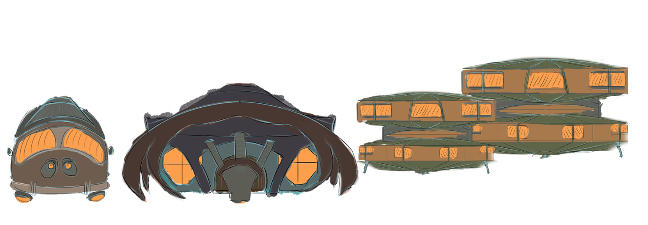
However, this design idea of mine was problematic in terms of placement and collision checks, as our main programmer pointed out. Our game was designed to have swarms of enemies , and less compact and more jagged or pointed designs like these would look out of place as they clipped over each other, confusing the player as they tried to determine what to shoot. And so we decided to keep the general idea of homes as enemies, but also borrowed from the original concept document.
While still homes, they now lack jet engines, are more compact, and have a themed look and color scheme (though this will be tweaked in coming weeks to make them more visible in the final art pass). The enemies (the one on the right side especially) were designed as they were to interlock, creating a row or snake-like form that could be broken apart by a player that fired at them, revealing them to be connected smaller ships moving in the same flight pattern. This larger mass of enemies will give the players an indication they need to fire at this threat repeatedly, as well as predict which enemy they will hit next based on the pattern of the group.
 |