The last few weeks have been extremely busy and it appears to stay that way for quite a while, blogging might continue to be inconsistent.
Below is a self analysis and conclusion of the 5-week project as a whole pulled from the project report that was written for the project. The chapters are missing, so it might be a bit jumpy.
From the start of the project the entire team felt that it all went smoothly and we felt confident that we had it right. Thus, making ourselves become blind to criticize each other and the project as a whole. Sort of the danger that you constantly hear of, designers falling in love with what they created, not seeing the faults and errors of their design decisions and ideas.
Throughout the project we lacked direction, the majority of the work done was basically brainstorming and putting a general idea down, then flesh it out as we went along. This, sadly, leaves a sort of mess that needs to be tied together in some way. However, that becomes increasingly difficult the longer you go on. This could have been improved upon massively by better planning from the start in form of writing down targeted milestones and so forth for each week.
Structure and planning matters.
The tools we used throughout the project worked fantastically and the group worked together great. The collaboration that was made possible by Google Docs was nothing but satisfactory.
We got started quite quickly with an idea, which we went with throughout the project and it was improved and iterated upon a lot.
The focus of the team was excellent, nearly all of the work was done in meetings where all members were present, which allowed the possibility for instant feedback and critique from each other.
Deciding on a set of milestones that needs to be achieved each week is something that in hindsight would have been a great addition to a somewhat loose workflow.
Having a basic work structure and planning ahead would have helped significantly. Also, allowing other people to read through our concept and critique what we had so far, would probably have helped us get away from the “Designers love” issue that I feel we had.
The paper-prototype wasn’t satisfactory at all, we tried to keep it simple as possible and focus on conveying the feeling of the game we wanted to achieve. This could have used a lot more work and we shouldn’t have ignored a lot of the mechanics we had thought about at this point. The mechanics and the intended feeling of the final product must be nailed down, the point of the prototype is mostly to see if the actual mechanics we want in game actually works.
Basically, we should have tested and experimented a lot more on the prototype than we did. The feedback we received after the prototype-test by Marcus was excellent and presented a lot of ideas and new mechanics we could introduce into our actual concept. After a few questions and explaining the concept we had in mind and what we tried to convey with our paper-prototype, the idea was judged as interesting according to Marcus, which did nothing but bolster our resolve to stick with it, which wasn’t necessarily wrong, however we could have used some harsh critique and questioning of our concept, rather than just great ideas and suggestions to improve the concept.
The test pitch prior to the final pitch went according to us and the jury decent, the critics we received was the actual pitch “theme” should fit the intended feel of the concept in general and rehearse it quite a few times.
The actual pitch, was us getting completely steamrolled. However, we received quite a bit of feedback to take with us into future projects.
The pitch in general is absolutely something we should have spent more time on, perhaps more as a group, considering this time around it was assigned to our presenter considering he was the one who was going to present it. Had we worked more collaboratively on it, it probably would have worked out a lot better and some of the issues may have been revealed prior to the final pitch. None is to blame other than the group as a whole.
The largest problem with our pitch was the fact that the audience had a difficult time knowing what was being presented at the time, without context, the message is lost. After seeing the other group’s pitches, I feel strongly that animated pictures (gifs) that help portray how the feature that is currently being presented works and functions would have been an excellent addition.
Another problem was that the structure wasn’t that particularly effective as well, which could have been helped with visual representations as previously mentioned. Too much text and barely any visual aid is not helpful and most of the time doesn’t represent the idea that the designers might have had, it might not be the same in the head for the publishers you are pitching for.
The team functioned together quite well, perhaps too well, our ideas were sort of synced and errors and shortcomings were missed. We would have needed an additional critical eye who constantly checked in and made sure that we were right on track, perhaps, in future projects, we should assign one individual outside of the team with a distance to the everyday decisions to take that role, to constantly question every aspect of each design decision in order to make sure it is a valid one.
The assigned roles never seemed to bother or hold back anyone and all the roles were fulfilled as was required in my personal opinion.
In short, things that I will keep in mind for future projects.
- Better planning
- Better work structure
- More eyes to take a look at how things look at predetermined milestones.
- Don’t fall in love with your first idea, let it go. It might seem like a non-issue despite being warned about it. It might not be apparent or obvious at all to the group considering on the fact that you are all working on something for a long period of time.
Don’t be afraid to criticize each other’s ideas, break them down thoroughly before proceeding, test all the angles and make sure the idea actually works before proceeding further.
Keep track on your progress as well. Keep written documents visible for everyone on what needs to be done, the milestones for the current week and make sure everyone in the team has something to work on. Also, don’t be too strict on the assigned roles, deviate from it and work wherever is needed, just make sure you don’t skip on the work that needs to be done for your own specific role. Basically, be flexible.
Do not fall in love with your first ideas and stick with them straight away. Test the ideas thoroughly through paper-prototypes, check if someone else made something similar on another game and see how that worked or didn’t work, if it didn’t work, ask yourselves why it didn’t work, can it be improved upon and so forth.
Another important thing to keep in mind, is the fact that more eyes on your project the better it most likely will become. As a group, it is quite easy to become blind after staring at things for too long. Make a milestone for every week, let other people in your class read it and come with suggestions and other critique, it might seem like a hassle and that you are a bother for doing so. It is worth it a thousand times over.
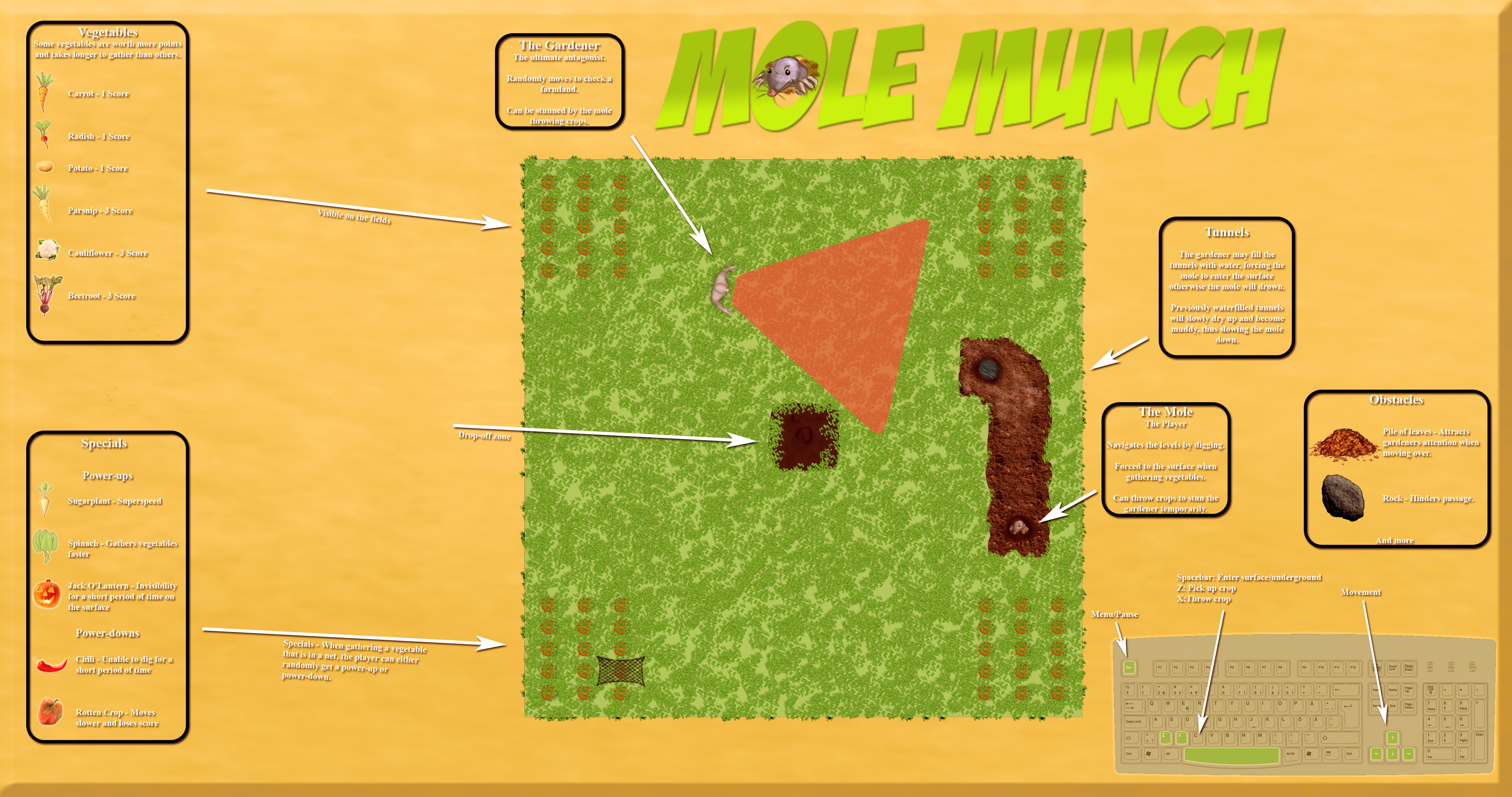
Final One-Page design below:
 
About Morgan Nilsson
2014 Graphics
|
