Clueless fancy pants. The paper prototype
|
Paper prototype. Methodology. Quite many changes has been done since the last time. As for the setup, we changed that the avatar is not the victim, instead one plays as the thief, breaking in to the mansion. We decided that this would facilitate the setup/story/mechanics, because now we could add items on the map that where more logical according to the setup, we could make the AI have real motives trying to kill the player. In the beginning of the project when the player was the owner of the house, we could not come up any good ideas regarding specific systems in the game, such as items and setup. For example we thought that the player should start of naked, with the goal of collecting lost pieces of his clothing. And that the thief would be the one who hunted the owner down. Speaking about it now sounds very weird. Now however, the thief(player) has to collect different items in form of valuables. In order to complete the course, the player has bring valuables that covers a certain sum of money to the exit. While the player collects the valuables, somewhere on the map there is the house lord who tries to hunt the player down. At the players advantage he has a boomerang to explore the fog of war with. (We made it a boomerang instead of an eyeglass) The items that you collect both have economical value and functional value. Here is a list of the different items and their properties: Candle: Increases field of view with one, so a total view of two grids. Money: Economic value, increases score at the end. Boomerang Glowstick: Increases field of view in thrown direction by three grids. You get one throw each turn. If it hits a wall, the enemy will notice the sound. Bear pelt: Gives the player the ability to hide on the floor, making you invisible to the enemy. Cannot hide with the bear pelt when carrying another item. Hiding removes a movement. Painting: Carrying it limits steps by one. It functions as a shield against the enemy, as long as you only moves towards him or sideways. Turning away to run will nullify the protection by exposing your back to him. Vase: Carrying it limits steps by one. If you get shot, the vase breaks but you survive. Armor: The enemy can hear you at all times when you wear it, it limits steps by one. You can hide with it, and if you get shot the armor breaks but you survive. Enemy can move the player hiding in the armor to another grid without seeing the player. Clock: Loose one step. If you get shot, the clock breaks but you survive.
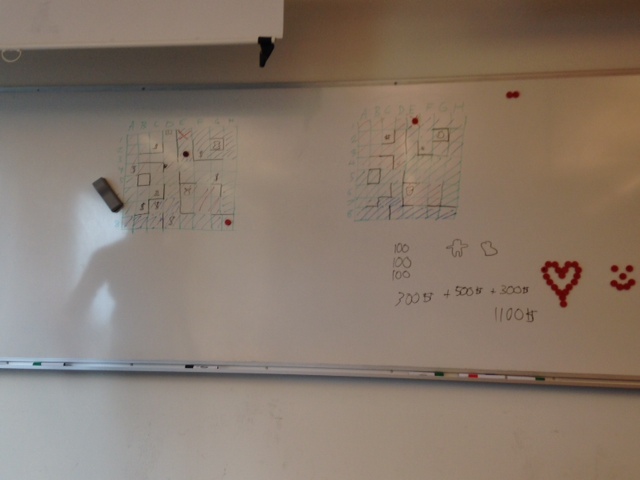
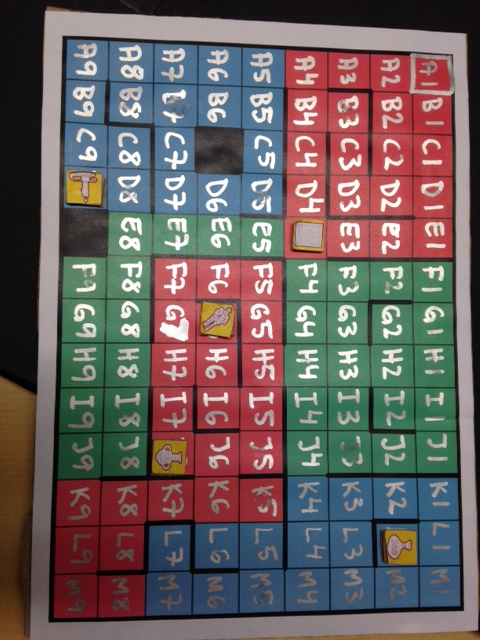
If you bring the items to the exit they will provide with a certain value. The combination of gathering items, avoiding enemy and limited field of view is our way to deliver the sense of challenge, clueless, exploring and tension. This is based on different sessions of test rounds that we performed on a whiteboard. The conclusion we made from the test session was that the mechanics where enough, we did not need to add any more. One thing that we noticed that we had to change was the balance between the player and the AI. One should want to take a risk to gather the items, without being helpless. So we added a stunning effect to the boomerang. Which later on proved to be TO helpful. We removed the stunning effect and allowed the player to move longer distances.. And the enemy could now place different traps all around the mansion. Which had the effect of stop the avatar for one round. This showed to work. The player could now feel it was worth to take risks, but not without any challenge. THE PAPER PROTOTYPE: We where given a task to construct a playable paper prototype of our game. Since we had a quite clear picture of how the map would look in the digital version, it was not difficult to apply this on the prototype. One thing that proved to be more difficult was to simulate the fog of war, and to convert realtime gaming to paper form. We simulated time by making the prototype turn based. By placing a numbered grid system on a a4 sheet, we made a system that was easy to comprehend in which it was easy to convert movement, much like chess. The fog of war was represented by a larger sheet of paper, which was cut in the middle were it showed the avatars field of view, originally limited to one grid vertical, diagonal and horizontal. Since we had an item that allow the player to see more, we had to make a whole new fog of war sheet, that had a bigger hole. As you see on the picture of the grid system, there are different colors that represents different areas. We used these to give the player a hint of where the enemy is, by saying in what area the house lord is moving after every move. This was used to give compensate for the limited view, to make the player able to orient on the map and to create scary climate.
We tested it a few times before we had to show it to our teacher. Just to make sure that everything was in place and that the game still worked. After some small changes it was time to show our work. Our teacher Markus, thought that the game delivered our aesthetic goals in a good way. The balance between enemy and player was good. He also thought that it was kind of scary, which was exactly what we wanted to deliver to the player.  |