Board Game analyze 2 ( Stratego)
Introduction
A group was assigned the task to play and analyze a game. In order to analyze we had to explain of the core system, components, system and the interaction between them and how the players interpret it. This is an exercise in understanding games and how they work, in order to learn more about what can make a good system and what can be altered. As Adam Mayes says: “Steal what you like and work with it”. One of the instructions was play the game 3 times as it gives you a bigger chance to understand the game. Stratego Original (1999)
We decided to play Stratego the original from 1999, as of course any original, three pieces was missing. This altered the perspective of this game a little and I will tell you why later on.
What is Stratego? Well to better explain what Stratego is I need to tell you about the pieces and some of the components first so I will tell you this first. Components
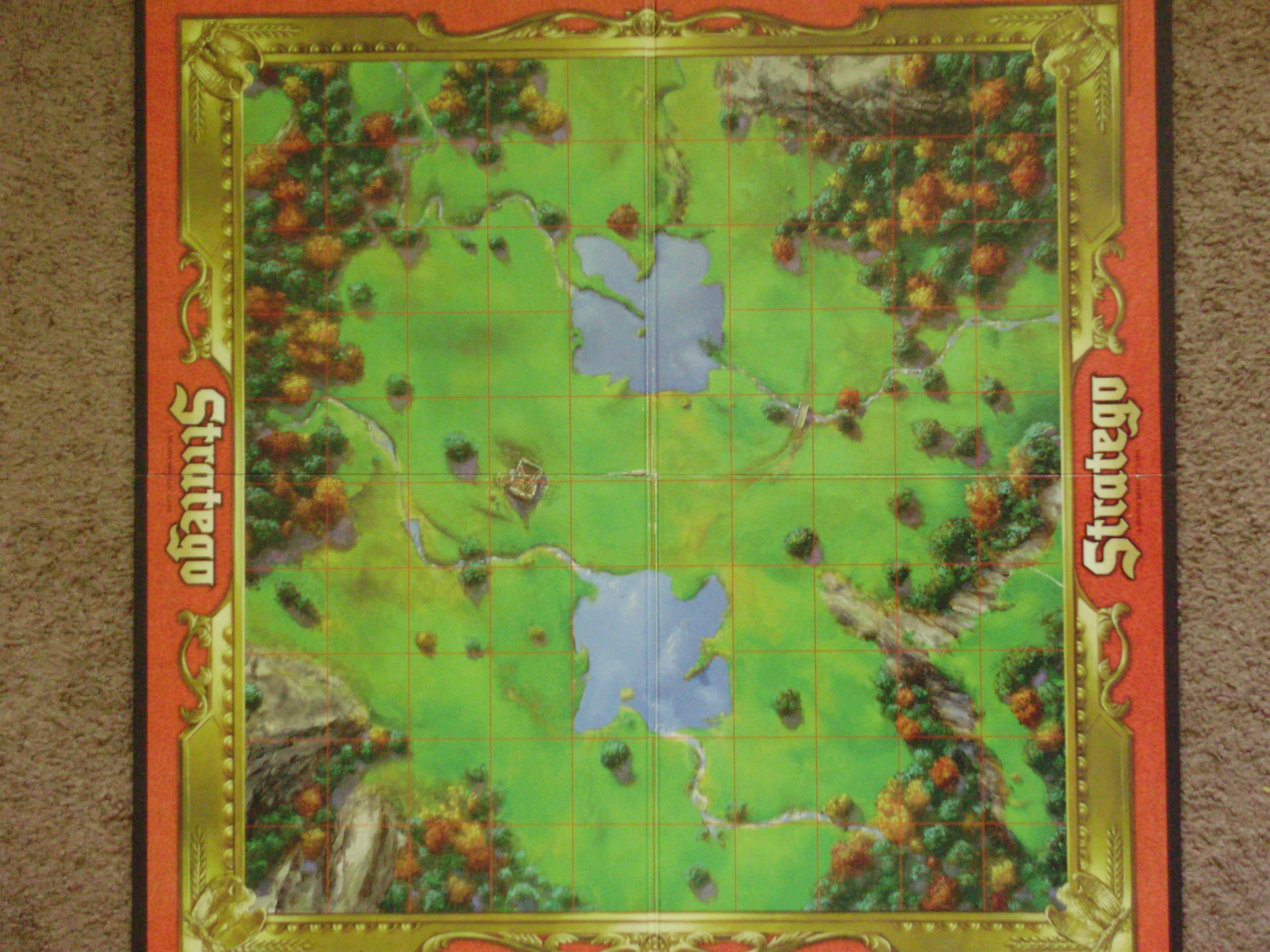
The first thing you will get at Stratego is a board with a 10×10 squares. In the middle of those squares there are 2 lakes that take 2×2 squares. Your pieces can never enter those lakes like in the picture bellow:
After this you get pieces that are the following: 6 Bombs 1 Flag 1 Spy (Rank 1) 8 Scouts (Rank 2) 5 Miners (Rank 3) 4 Sergent (Rank 4) 4 Lieutenant (Rank 5) 4 Captains (Rank 6) 3 Majors (Rank 7) 2 Colonels (Rank 8) 1 General (Rank 9) 1 Marshal ( Rank 10) And you will get a cardboard screen. Let me explain the pieces and the ranks for you. All pieces are in the rank because every higher ranked player defeats a lower ranked person. There are only 5 differences in the game and they are the following. Spy (Rank 1) – If it attacks the Marshal he will die, The spy is the only character that can take out the Marshal. Scouts (Rank 2) – They can move as many spaces as they want. Miners (Rank 3) – Now the Miners might be the most important pieces you have on your board accept the flag. Miners are the only unit that can take out the bombs. Bombs – Nothing else but a miner can take one of these bad boys out. So tread carefully. The flag – The most important piece of them all, if an enemy declares an attack on this flag they have won. So a good tip is to surround it with bombs.
What is Stratego
Stratego is about tactical decisions and troop placement, so let me tell you about the setup: At first you put up the game board and put the cardboard screen between you and your opponent. The important part to know here is that the lakes shall be between the two players in the middle. After that you put up all your pieces in order you want it to be, preferably defending your flag. After the match is done only you can see the units you have as the back of your pieces are hidden.
Now it works like chess. You can only make one move or attack every turn. The only person that can move more than one square at a time is the Scout. The movement are also restricted so that you can’t move diagonally. Red player always starts first. Every time you want to attack a piece you have to tell the person the rank on the piece and he has to declare his. If the same ranked pieces attack each other they will both die.
Round 1The following pieces missing from the board were 1 Bomb, 1Miner and something less important. Since my opponent never played this game before made it more interesting, because we both said the same thing when we started… “What was I thinking with this placement?” Now for the first round I felt like I had total control on his side of the board. I knew were Marshal and Spy were sadly so did he. But then something happened that I was not prepared for at all. I only had lower ranks below in the base thinking they could defend because we were pretty even, suddenly he moved in with a Colonel and a General. I managed to use one General of my own to take out his but the Colonel went on a rampage and since it was the first time I actually were nice and had an entrance to the flag. That was stupid, because the Colonel actually managed to go to it without hitting a bomb, and I lost the game completely. Man I felt stupid but it was manageable. For the first round movement didn’t take too long we moved what we felt was right and both have almost the same strategic mind so it went really smoothly. That said I could tell that against someone that thinks a lot this might be hard game to play.
Round 2Now this round was interesting. My friend tried a tactic were he blocked all the entrances with bombs. Because I noticed right away that he did not move those pieces I decided to test out if it was so. A miner took out a bomb on the other side and his plan fell apart. After that we managed to take out a lot of the high ranked officers and were left with our 10, 6 and lower. Except me. I were actually lucky and managed to save one Major. It was a blast because when he made the mistake of trying to take out my Marshal with his my major could actually go in and go on a rampage like he did to me the last round. Victory for me!
Still no problem with waiting time but we took a little longer to figure out what to do.
Round 3What to do what to do. This round was amazingly fun but it gives it away that we decided how to play at the beginning. We wanted to see if you were able to make a draw in this game. Turns out it’s really hard to but you can. There is only a small probability of this happening though. What you need is for everything to die accept 1 piece each with the same rank. Then they need to attack each other and the game ends a draw. This was really fun because we just had fun and played it like we both wanted to loose ending up with one Marshal (mine) to blow himself up attacking a bomb that 3 others already had died on.
Differences in gameplayBecause we were missing three pieces and could not replace them because of the “you are not supposed to know what your enemy has” detail. We actually had a little more tactical choices and movement. Because of this 3 small holes were left on either side of the game field making so that you could alter were ranks were depending on the situation. I would say always leave 3 pieces out if you play this because realization hit me. If you have an army and you see another army rushing towards you taking out one of your first defense troops you usually would order parties of that army to change places real quick so that you could make sure to counter the impending enemies. To me this was more realistic in some way and in others not. Because the characters could not jump over one and other this felt as natural to me as someone yelling “Archers to the north” and they reply. If all the pieces were in the placement of your troops would be really important and could end the game a lot quicker than you want it to end. I can’t say for sure since we did not find those pieces but, for some reason I can see the game being a little too harsh then .
But I might be wrong since this is about the troop placement on a field and then having a battle there.
Core mechanicsSo when I tried to break this game down into the smaller components of this game I would take it down to this. Troop placement: The most important part of the game is where your troops are and how you can move them to support your team. If you place it completely wrong (even with 3 empty spaces) it can make your team lose a lot of troops really fast. Tactical thinking: You need to remember every piece you lost to because if you forget it then you could lose a really important piece to a bomb a second time and that would blow so to speak. Target interpretationNow the target for this game is a little harder to set than I originally thought. If you look at all the different type of box art that is on the web it’s a game for everyone. Usually the art is Soldiers riding into battle against the person looking at the box or the opposing army. From what I can tell it’s a very action packed box art and would probably be aimed for boys and men from the age of 11 – 99. Most men find war interesting and that’s why from the box art I would say that the game is for the male around the age group of 11-99 years old. But for actual gameplay it’s a good starter game for those who want to become good in strategic thinking and games. So I would say that all ages from 11-99 could play this game.
Summary
This game is interesting in the way that you can think you have total control over a situation but all it takes is one piece to change it all.
The good sides – For a strategic game it sure makes it interesting in the way that you have to remember your opponents pieces rank after you have spoken it. I can see that this is really good if you want to train someone’s short term memory. I would actually say that the not knowing what you have is the most interesting part of this game. The reason behind this is one element that you don’t have in most strategic games, bluffing. Well okay you can bluff in strategic games but this is different. For instance you can make a person think you have a really strong piece protecting a entrance but it might be a really week one, making the other player fall because he moves his troops in order to avoid getting taken by the believed enemy. Because this game is pretty much played blindly a game can end a lot quicker than a game of chess. Bombs stay on the field even after someone walked on one. This is good mostly because you can manage to take out more than one unit for the enemy with one bomb if he manages to forget it. The only down side I see with this is something I will mention below. It does not make sense at all. A bomb blows up and disappears; I managed to get around that by saying it was a “mine field” or “bombardment square”. The bad sides- I would say that the bad side to the game are almost none existent, for a game designed for a strategic flaw it has close to none. “Close” being the key word, this is the original game so I might find a different version having different rules to be more interesting but here are the bad sides. The same rank taking out each other. I only put this on bad because of one reason, this feel really good in the game because you can defend yourself that way but you also lose your piece. It ended on bad for the simple reason of not making sense. Even if you are the same level of swordsman the people that attack out of surprise usually win. It’s a tactical advantage, so then the same ranked that attack should take out the defending with the same rank. Playing with full board on both side leaving only 12 squares empty, would make it feel less like a game were you have control over the battlefield. You usually had a signal to make a unit move around so that you could make a quick alteration so you could counter, flank, eliminate, destroy or bait your enemy. I like the idea of having the possibility to change your ranks so that you are better prepared, making sure you can take the oncoming slaughter.
I would recommend those who like strategic games and want to play it with anyone from the age group 8- 99 to play this game. |