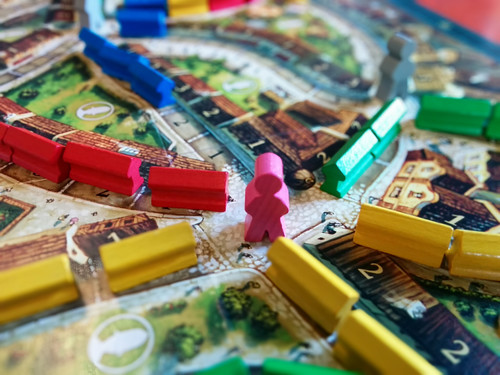
Board Game Analysis 2 – Portobello Market
|
We were yet again tasked with playing a board game and then write an analysis of our experience with that game. The main goal is to get an understanding of the core systems and how they affect they game. We chose to play Portobello Market. To gain as much understanding as possible of the game and its different play styles, we decided to play the game on three times. IntroductionPortobello Market was released 2007 by Lautapelit.fi and can be categorized as an (family) abstract strategy game for 2-4 players and is similar to Carcassonne and Monopoly. The game won “Årets Spel” and several other awards during 2007 and 2008. The goal of the game is to have more points at the end of the game than the other players by strategically placing your market stands on the streets of Portobello Market to gain a majority of said street. Having a majority will gain you more points and privileges. The game starts with the player who visited London last choosing how many actions she will make during that round. This is represented by the different “Action tabs” (handlingsbrickor) which have a 2, 3 or 4 printed on them. Action Tabs – where 2 and 3 have been used and flipped. If the player chooses to use 2 actions, she will flip the corresponding action tab to show that it is activated. With this activated she can either place two market stands on a connecting street where the “bobby” is standing, two customers on any square of her choosing or she can place one market stand and one customer. This tab is now used for this round and cannot be used again until the 3 and 4 action tabs have been used. When this happens, all the tabs are flipped to their original way and can be used again. These tabs can also be turned into “District Markers” (Distriktmarkörer) which act as a score multiplier for a certain district. To turn the tabs into one of these, the player has to place the tile down by the streets that the multiplier should be used on. The player is now one Action Tile short and has to draw a new one from a pile of extras. The difference between these and the ones the players start with is that the extras only give the player 3 -1 actions instead of 2-4. The 4 Action tab have been used and is currently on the board. Blue player has now taken an extra tab (3) and can now use that as an Action tab. The board is built up of streets with segments which are valued differently (1-3 points), all connecting to town squares. The players have to place their stands at the end of a street and build from there. This means that when another player comes along and wants to continue to “build” on the same street she will have to continue where the other player left off. Once a street is filled with market stands, the sum of those valued segments will be taken into account when calculating the final score of that street. There are 11 customers; 5 aristocrats (pink color), 5 citizens (grey color) and one baron (black color). A customer is drawn randomly from a bag and then placed as an action by the player on one the 11 town squares. All but the Baron which is placed once all the other customers have been placed. To gain any points from a finished street, the two connecting town squares needs to be occupied by a customer. The score is dependent on what color the customers on the connecting squares are:
1 Aristocrat (Pink) and the Baron (Black) are standing on town squares to give the Red player a lot of points. These are then multiplied with the score amount that your stands have been placed on. E.g. Two pink customers are placed on the connecting town squares. Blue has 3 market stands on a 5 segment street which gives Blue a total value of 6 and Yellow has 2 stands on the same street with a total value of 5. This means that Blue gets a score of 18 (6×3) and Yellow gets 15 (5×3). The function of the bobby is to mark where the players can place their stands, since they can only place the stands on the connected streets of where the bobby is. The bobby can be moved to another location at any time during a player’s turn, but it might cost you some points. The Bobby can be move freely across streets where you as the player have a majority. If there are no stands of the street, the player has to “pay” a point by moving one place back on the scoreboard. If another player has a majority you have to pay a point to that player (she can move forward one step) and you have to go back one. The bobby can in this example be moved by the Red player free och charge since she has the majority of the street up ahead. First SessionAmount of players: 4 Time played: 30-40 minutes. The first session was, as with the previous assignment, meant for use to get used to the game and how it plays and not so much for analyzing. What was clear from the first session was that everyone used the 4 action tile as fast as possible to get as many actions as they could. By the end of the game we realized that this might not be the best strategy since you might want to have a lot of actions left at the end of a round to make some moves for your gain and some moves to hinder the others/react to their previous actions. We also talked about the bobby and how it should cause the players to lose and gain more points. There was a big distance between the players, scoring wise, so -1 or +1 point did not really matter. Second SessionAmount of players: 4 Time played: 30-40 minutes According to the rules, the person who most recently visited London should start. But unless the game is played several years apart, there is a low chance that the starting player will be changed. The action tiles were used in a different and more strategic way which showed to benefit the players a bit more since they could plan their actions more carefully and save the bigger action tiles for certain situations. We also unintentionally did not place down any customers in the beginning, which gave us no points at the start and caused the bobby to stay stationary. Hence, we were forced to place our stands in a much more focused area. Once the customers were starting to be placed out, we noticed how the citizens were placed in some sort of “slum” where no one wanted to have their stands. Everyone wanted to connect their streets to the pink ones, since they have a higher value. Third SessionAmount of players: 2 Time played: 30 minutes The third time we played, we decided to switch it up a bit and play with the minimum amount of players, which gives the players more market stands to use on the board. We also decided to try the alternate way of picking the customers. Previously, they were hidden in a bag and had to be randomly drawn by the player. This time we put them in a random order and displayed them to the players. This meant that they could plan more carefully and use them to disrupt the plans of the other player. What WorksPortobello Market is an easy-to-learn game, quite fun and the systems feels solid. What works the most is probably the placement of the market stands and how straight forward it is. There was no confusion in how the score should be counted and the “formula” for it is logical. The 3 different types of customers also works well and adds another reason to plan your placement and a dynamic of being able to disrupt the plans of the other players. What Does Not WorkThe point system can be somewhat problematic. The actual design of the value of your stand x the value of the customers x if a multiplier is used is easy to understand. But sums which should be calculated can quickly become quite large and scoring for certain streets takes a while to calculate. Sometimes you might want to get your phone to quickly do the math for you. It never causes a headache but is still enough of a hiccup to interrupt the flow of the game. Also related to the point system is the scoreboard, which goes around the game board so that you can keep track of your points. What does not work is the desired sense of competition since there are always huge gaps between the players and there is rarely a race to the top by the end of a session. Some tweaking of the point system might create a more tense feeling Target AudienceThe publishers have recommended the game for players of 8 years old and up which is a fair assessment. But the point system will require some thinking so players need to be prepared for that. All in all I would say that the game should be recommended towards people (8 years and up) who like a simple and quick family strategy game like Carcassonne or want to play a simpler game than Monopoly, but they like the strategy it brings. SummaryThe core system of the game is the placement of the market stands and the customers. It is the system that rewards you points and makes the game move forward. We had a small discussion regarding whether or not placing market stands and customers are the same system. On one hand, the market stands and customers have different attributes and affect the game differently. But on the other, they are still used within the same system which is the actual placement. All in all, Portobello Market is a fun and quick game you can get the hang of fairly easily. The systems feel tested and well put together! |