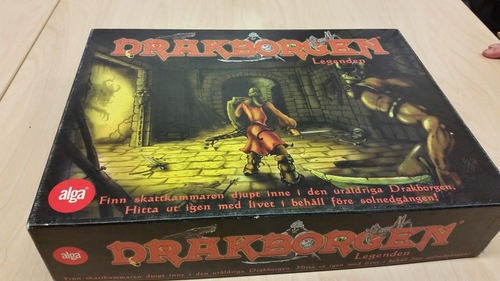
Board Game Analysis 1 – Drakborgen Legenden
IntroductionWe were tasked with playing and analyzing a board game of our choosing as a team and then individually write an analysis of our experience with that game. The main goal was to get an understanding of the core systems and how they affect they game. To gain as much understanding as possible of the game and its different play styles, we decided to play the game on three separate occasions. The game we chose was Drakborgen Legenden. Drakborgen LegendenDrakborgen Legenden, released 2002, is a renewed version of the classis Drakborgen (DungeonQuest), released 1985. The new game has a more demanding combat system and an overhaul of the game’s systems overall. Drakborgen Legenden is turn based fantasy adventure board game where the goal of the game is to explore and collect loot in the ruins and catacombs of a castle. Within in this castle, there is a sleeping dragon guarding a large amount of treasure. The players need to collect as much treasure as possible before they die, either from other players, monsters in the ruins, the dragon or before the sun sets. Each player chooses a character avatar at the beginning of the game. These characters are of different races and possess different skills, which are printed on the cards. Each player should also draw a “Ring Card” which acts as an extra ability. The 2 layered Tiling System The board consists of a grid where different Labyrinth tiles are placed face down. A tile is then flipped once a player decides to walk to that particular tile. These tiles hide everything from straight corridors, rooms with doors to new possibilities, dead-end, etc. This creates a random looking level each time the game is played. Some of these tiles are also accompanied with “Room Tiles” to give the players loot or encounters with monsters. The combat system between players and monsters (and also other players) starts when a player enters a room where the enemy is. Both the player and the player controlling the enemy (often the person to the right of player who entered the room) have to now refer to their Avatar Stats Card and their Combat Dial. Each character has different point in the same traits; Agility (VF), Strength (SF), Psyche (PF) and Armor (RF). With these traits, alongside the Health Points (KP), the players now have to play their stronger traits and hope that they trump their enemy. The Combat Dial is a small circular tile with the VF, SF, PF and RF printed on it in a squared fashion. The two fighting players have now 7 seconds to choose one of these traits to use in the fight before they reveal their choice to each other. To see what traits have been chosen, a black marker is placed on top of that trait. If both Player A and Player B choose to play their VF but Player A has a higher amount in that trait, Player B will be trumped and loose KP. At the next turn (if the Player B is still alive) the players now need to choose a new trait (or stay on the same) but they can only move the black marker one step to the left or right of their previously chosen trait. If the two players chose traits that are on the opposite side of the dial it counts as a “miss” and they play again and no one takes damage. This goes on until one character is dead. The Combat Dial (w/ the black marker)
The core components of the game are players and their Avatar Markers, Combat Dial, the Avatar Stats Card, two six sided dice, one 12 sided die, the Labyrinth and Room tiles, the time counter and a multiple of special card decks. First SessionWe saw the first session as more of a chance for us to understand the rules and mechanics of the game, rather than starting to analyze right away. The game is accompanied with several instruction books and rule sets which made us aware that we would probably miss some aspects and fail to play by some rules. One instruction we knowingly modified was the placement of the Labyrinth tiles and the Room tiles. These are supposed to cover the whole board within the grid system, but even before we began we knew that it would create problems. If one tile is accidentally pushed or moved, it would move every connecting tile out of place. We would have to constantly rearrange the tiles to keep them in place instead of actually playing the game. We solved this by just placing the center tiles, where the dragon is hidden. The other tiles were stacked next to the board and were drawn each time the player needed one. This worked well and probably cut down the play time by a whole lot which was already reaching three hours even though we cut it short from people needing to attend other things or were too frustrated with the outcome of the game. This attended placement method of the tiles was something that would be seen as a nuisance throughout our play sessions. Our modified and simplified system for the tiles. As previously stated, we didn’t analyze the game at the start since we wanted to know the rules before playing. But with having to constantly revert to the instructions gave me the thought of that the different elements and how they were presented didn’t feel natural. If a player encounters something new in the game and he or she is surprised and confused as what it does, it feels as though it is not very well designed and the different aspects might feel somewhat forced. The Sun Dial The biggest problem we had during our first session, apart from our ignorance of the rules, was the Sun dice and the Sun Dial. The game can end in different ways, either through the player exiting the ruins or by dying by the hand of monsters, other players or the dragon. The third way is if the sun sets, which is decided by the Sun Dial and the Sun die. At the beginning of each round, a player will roll the dice to determine whether or not the sun should move one or two steps or remain at its current location on the dial. Once the dial reaches the end, all the player will die unless they have exited the ruins. During our first session the dice came up with almost nothing but “clouds” which won’t move the sun. This prolonged the game and made everyone frustrated. Second SessionThe second time we played the game we had read the rules more thoroughly and we also did some research on parts that confused us the first time. We decided also to not modify the tile system this time, since that is the way the game is intended to be played. We all also chose different characters this time around to try out as many different classes as possible. One thing that was lacking the first time we played was combat encounters with monsters. So to increase combat, we decided to play with a PvP element that we chose to ignore last time (It was ignored to help us experience as much as possible without killing each other off in the beginning of the game). Unfortunately, no players were ever close enough to each other to fight during this session. The amount of monster encounters happened more often though! But we quickly realized that every player tries to avoid combat at any cost (unless some reward was given if the monster was beaten. This is seldom though). The combat system is set up so that the player can, apart from fighting, flee or wait to see how the monster reacts. There is no “punishment” for trying to avoid battle and no reward for engaging in it. This makes the combat feel useless and you often sigh when a troll comes your way. The tile system was something we were bothered with, but it wasn’t as bad I first thought it would be. That might be because we were careful when lifting the tiles to ensure that as few tiles as possible were disturbed. Even though this worked, I think that just grabbing the tiles from a stack was much simpler and quicker. It seemed like an unnecessary hassle. The Sun Dial worked a lot better this time and towards the end we actually started to feel quite stressed about making it out of the ruins before sunset. But it was still not something that was nibbling at our heels during the game and it didn’t affect our play styles that much. Third SessionDuring our third session we felt quite confident in our knowledge of the game, even though we referred to the instructions every now and again. This time we used the modified tile system but we kept the PvP aspect. With our knowledge and modifications we had quite fun playing! Everything went fairly smooth and quick. Some people started to attack each other and we got a full round where we encountered lots of monsters and loot and the Sun Dial worked as a stressful bystander. One thing we noticed was lacking throughout all of your play sessions was that backtracking to already explored rooms was too uneventful. Backtracking is a big part of the game when your try to exit the dragon’s lair and the ruins itself since you want to take the fastest route which is the already explored one. With nothing happening, the end of the session usually is just the players going in turns to take one step back to the exit without any events happening. This could probably be avoided by having to draw an extra Room tile every other or every third room you enter. What Works?The game is designed to give the players a different experience every time they play it and this works well to a certain degree with the tiling system which offers different layouts of the ruins and the encounters with monsters and loot can never be predicted. Exploring is the main idea of the game and this is encouraged since the players can find valuable armor or other items around the map to help them against the dragon and the other players. The greatest thing with the game and the most interesting system is the two (similar) risk and reward systems. These systems can be explained as “The Exploration Risk and Reward System” and “The Dragon’s Lair Risk and Reward System” The Exploration Risk and Reward System is put in place during the main part of the game where the players are scavenging around the board to find the dragon’s lair. The players know that the lair is within the 9 most centered tiles and can just go right towards that group. To be as fast as possible and reach the dragon before the others, he or she needs to plan the movement of their avatar to pass as few rooms as possible. This means that there is a smaller chance of the player finding items that can help with the possible battle against the dragon, but he or she will reach the dragon first and might steal all the valuable loot from the other players. Another tactic in this system is to explore as much as possible before searching for the dragon. With more rooms explored, this gives the players a higher chance of finding helpful items but it might not matter if a faster player is skilled enough to reach the dragon first and steal everything. Players approaching the Dragon! The Dragon’s Lair Risk and Reward System takes place within the lair of the dragon. Once a player enters it there are two decks of cards that the player needs to draw by each round. One card from one deck shows the player what treasure he or she grabs at that round another deck decides whether or not the dragon is still asleep or if he awakes. One card from each deck must be drawn at every round if the player decides to steal treasure. If the player decides to leave the lair, he or she needs to roll a dice to determine if their skills are good enough to exit at that round and also draw a card to see the state of the dragon. You have to constantly debate whether you should stay and collect more treasure and risk waking the dragon or get out as quickly as possible. What Does Not Work?The tile placement system seems illogical and untested. Having the board covered in two layers of tiles which move away from their place at the slightest touch will cause confusion and frustration with the players. I understand the thought behind it since the ruins are supposed to have a random layout and placing the tiles on the board will “lock down” the choices of those tiles to be used. But to pick tiles from a pile on the side has the same function and is more convenient. An attacking Werewolf! Combat feels dull and unmotivated. We felt this from the start of the game with the first encounter since there is no gain from actually killing monsters (apart from surviving of course) and you often lose some KP. This means that you try to avoid battle by fleeing or hoping that the monster flees so that the combat can be avoided. PvP combat does not have any real function either, apart from just messing with the person getting killed, since there is no gain from it. If the players could steal treasure and loot from each other after one of them dies, it would create a tension between players and create a new dynamic where alliances could be formed and backstabbing could take place. Target AudienceThe back of the box does not give us that much information about what the target audience should be, apart from 10 years old and above and that the game is an adventure game. But if we take a step back and just get a glimpse of what the game is, the story is about and what you do in the game we see that the game is similar to a Dungeons and Dragons-style roleplaying game but without the advanced story element and the game takes place on the game board rather than pen and paper. So we can say that they target audience for Drakborgen Legenden is people (especially young adult males) who would like to try a simpler and shorter version of a roleplaying game. SummaryDrakborgen Legenden definitely has its ups and downs, with the downs mostly being the feeling of untested mechanics and systems. Every system in place works but with some tweaks these systems could work really well and actually engage the players without taking away anything from the game. Out of Marc LeBlanc’s “8 Kinds of Fun” I’d say that Drakborgen Legenden could probably tick 4 out of those boxes: Discovery, Challenge, Fantasy and the most important for a party board game; Fellowship. But the feeling I get from the game is that I’m playing by myself all the time. Sure, I have the other players roaming the ruins at the same time but my character never has any real connection or relationship to the other players. I’m only focusing on my character, the loot I find and I never have to plan ahead to avoid or deceive the others. Some implementation of player interaction with other players would take this game to a whole new level. Even though a lot of systems feel incomplete or not thought through, the risk and reward systems are exemplary and they are a reason to try the game just to experience. |