|
Earlier this week, we had our first real lecture in our Level Design course. In the lecture, our teacher (Ernest Adams) mentioned a couple of principles that you need to take into consideration when you are designing a game and design the levels inside the game. During the lecture, I started to thinking that I should do an analysis of Counter-Strike: Global Offensive’s competitive mode after those principles.
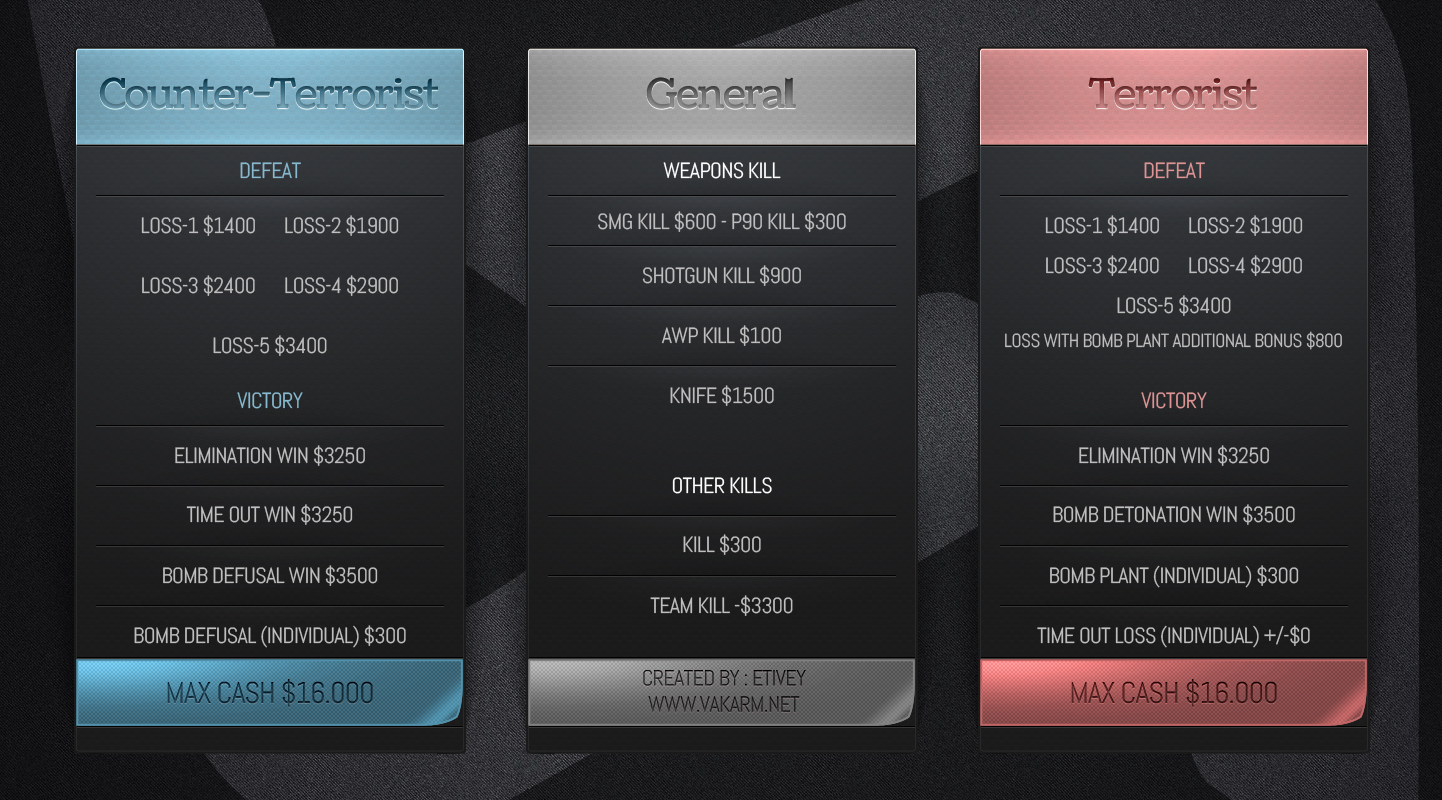
But before I start talking about that, you will need to understand how CS:GOs money system works. This image below belongs to http://www.vakarm.net/ and it explains how the money system works on defusal . What isn’t mentioned here is that each player begins the game with 800$ and a full list of what everything costs can be found here. Each competitive match is played over two 15-round halves (the player swaps teams after 15 rounds) and the first team to get 16 rounds wins.
Now, lets get down to business and analyze one principle at a time. I’m only analyzing the points I find relevant for analyzing CS:GO.
When the player defeats a challenge, replace resources he consumed
In CS:GO, this is done in the form of giving the player and his team some cash when they manage to achieve something in the game like getting kills or planting the bomb. The cash can then be used to buy new grenades, armor or weapon later on in the game. It may not seem like much, but in competitive CS every little amount of money matters.
At the start of a new round, every weapon the player has managed to save gets fully replenished with ammunition. Grenades is however not reset at the end of rounds and have to be re-bought. It doesn’t replace everything the player used, but it does restore some of the resources used.
· Be clear about risks and consequences
This is one thing that is very clearly present in competitive CS:GO. If you don’t think of what you are doing inside the game, you might very well lose the round, which in term is going to hurt you and your team’s economy in the long run.
This is also present when you are constantly firing your weapon. Not only does this alert your enemies of where you are, the recoil of the weapon can also make it so that you actually don’t hit anything of what you are aiming towards.
If you die, you don’t keep anything your carried during the last round; you start over with just a knife and the default pistol, meaning that you have to re-buy everything again. This makes it clear that you shouldn’t take any unnecessary risks in the game.
Be fair to all the players
This is a little tricky to analyze in CS:GO for a couple of reasons. While the rules for getting money inside the match is the same for everyone, and Counter-Terrorists can freely choose if they want to replace their M4A4 and P2000 with the M4A1-S and USP-S respectively, there are still a couple of points that makes analyzing this point a bit tricks
1) As my friend Inge said to me while we were playing the game, the reason to why the Counter-Terrorists weapons and equipments cost a bit more than the Terrorists is because they usually have an strategical advantage on the maps inside the game on defusal maps. And on hostage maps, Counter-Terrorists can get lots of cash even if they don’t win the round, because reaching hostages rewards quite a bit of money.
2) While it may be a Best-of-30 game, you still have to take into consideration that the teams first plays 15 rounds on one side, and then switches sides for the next 15 rounds. While this may seem like a good way to balance out the fact that all maps might not be entirely balanced, and therefor forcing players to play well on both sides, winning the first half of a match can still give a psychological advantage over the opponents.
3) And of course, lots of balance is not just about weapons and cash, it’s also much about level design as well. Some maps are IMO much more balanced than others, which makes it hard to analyze it in general as well (especially as a relatively new CS:GO-player)
In the end, I still do think that CS:GO is fair game for all the players, however if we also take the mental human factor into consideration as well, it’s get a bit tricky to analyze all of this as well.
Use big rewards and small punishments
In CS:GO, this principle is more used like big rewards, big punishments. If your team gets killed and loses the round, you only get a little amount of money initially, while the winning teams gets more money and the surviving players gets to keep their weapons. But the more rounds you loses in a row, the more money your team gets, meaning that it is not entire over only because you lost a round.
When it comes to kills, the kill amount for each weapon is there to balance out the risks with certain weapons. For example, the reason to why a kill with a knife awards so much money is because you have to be in your opponents face in order to be able to deal damage with the weapon. Shotguns also rewards the player with extra money because they are only good at close-combat.
The reason for why the AWP rewards the least amount of cash per kill is because of that the AWP is one of the best weapons in the game; it will 1-shot kill any opponent in the gets aside from hits in the legs, it is a very accurate weapon even at long distances while the player uses the scope and it can penetrate through most materials and even players inside the game. However, it also comes with a couple of disadvantages as well, meaning that it is a high-risk, high-reward weapon.
I think the reason to as of why CS:GO does it this way is because in order to keep the game interesting. I don’t think competitive CS would be very interesting if the principle of big rewards/small risks was used in this game.
|